Competitor Analysis for SA Makers: A Simple Guide
September 25, 2026 · 14 min read · Elizora Yarnell
You've opened your online jewellery store, added beautiful product photos, and set prices that feel fair. Then the first doubt arrives. Is a handmade beaded bracelet at the right price? Are customers comparing it with a cheaper imported item? Does another local maker offer faster delivery or easier payment?
That uncertainty is normal. Competitor analysis gives you a practical way to replace guessing with useful observations. You don't need an expensive research team or a complicated business degree. You need a notebook, a few public websites, and the willingness to look closely at what other sellers do well.
Table of Contents
- Why Knowing Your Rivals Helps Your Online Store
- The South African Market Reality You Must Understand
- A Simple Step-by-Step Competitor Analysis Framework
- Templates for Tracking Product Features and Pricing
- Local Examples and Lessons from South African Makers
- Turning Research into Action on Your Shopstar Store
Why Knowing Your Rivals Helps Your Online Store
A maker named Lerato launches a small jewellery shop on Shopstar. Her photos are bright, her packaging is neat, and she knows the time that goes into every piece. After a quiet first week, she searches for similar jewellery online and notices that other sellers explain their materials more clearly, offer gift packaging, and answer common sizing questions before customers ask.
Lerato hasn't failed. She's found information that wasn't visible from inside her own business.
Competitor analysis means studying other sellers so you can make better decisions for your own store. You look at their products, prices, photos, descriptions, delivery promises, payment choices, social posts, and customer feedback. You aren't trying to copy their branding. You're looking for patterns and gaps.

Look for decisions, not secrets
A rival's store can help you answer practical questions:
- Price: Are similar items positioned as budget, everyday, or premium?
- Product: Which materials, sizes, colours, and bundles appear often?
- Trust: Do shoppers see clear returns, delivery details, contact information, and local payment options?
- Message: Does the seller focus on handmade quality, personal meaning, gifting, sustainability, or convenience?
- Experience: How easy is it to browse, choose, pay, and understand what happens next?
You might discover that your price is reasonable, but your product page doesn't explain why. You might also learn that customers value a small feature your competitors overlook, such as adjustable sizing or a handwritten gift note.
Practical rule: Study competitors to make your own offer clearer, not to make your shop look like theirs.
A useful companion to your research is this creator guide by taap.bio, especially when you're trying to turn observations into a distinct brand position. Once you know what other stores offer, you can choose where your Shopstar store should be easier, warmer, more useful, or more memorable.
The South African Market Reality You Must Understand
South Africa's business environment is not evenly spread. The Competition Commission's 2026 Concentration Report found that between one-third and one-half of South Africa's 228 economic sub-sectors were still highly or moderately concentrated after some improvement since 2017. The share of highly concentrated sub-sectors fell by 5 percentage points, and 10 sub-sectors moved from high to moderate concentration. The report analysed roughly 450,000 tax-registered firms covering 2017 to 2021.
That matters to a small online shop because your most visible rival may not be your only rival. A local maker can compete with a national chain, a marketplace seller, an Instagram business, and a customer who chooses an entirely different product for the same occasion.
Statistics South Africa reported that 40% of the economy was highly concentrated with a presumptively dominant firm, while less than 10% was not concentrated. The top 10% of firms accounted for 86% of total turnover, while the bottom half shared 1.6%. At the same time, 95% of companies were small, medium, or micro enterprises, but they contributed only 24% of the company tax bill, according to the Competition Commission coverage published by IOL.
What concentration changes for a maker
These figures don't mean you should try to beat a large retailer at everything. You probably can't match its buying power, warehouse network, or advertising budget. Your competitor analysis should instead show where a large player feels less personal or less specialised.
Look for openings such as:
- Specific identity: A jewellery shop for bridesmaids, new mothers, or proudly local gifting.
- Personal service: Sizing help, custom colour choices, or direct WhatsApp conversations.
- Product meaning: A clear story behind the materials, design, or maker.
- Focused selection: Fewer products that solve one customer's need well.
Your research should also include people who sell a different product but satisfy the same purpose. A handmade jewellery brand may compete with clothing boutiques, gift boxes, salon vouchers, or imported accessories when shoppers want a birthday present.
Before you copy a rival's price, speak to potential buyers. A simple focus group research guide can help you test whether customers care more about price, design, delivery, packaging, or the story behind the item. That answer is more useful than staring at a competitor's product page and guessing.
A Simple Step-by-Step Competitor Analysis Framework
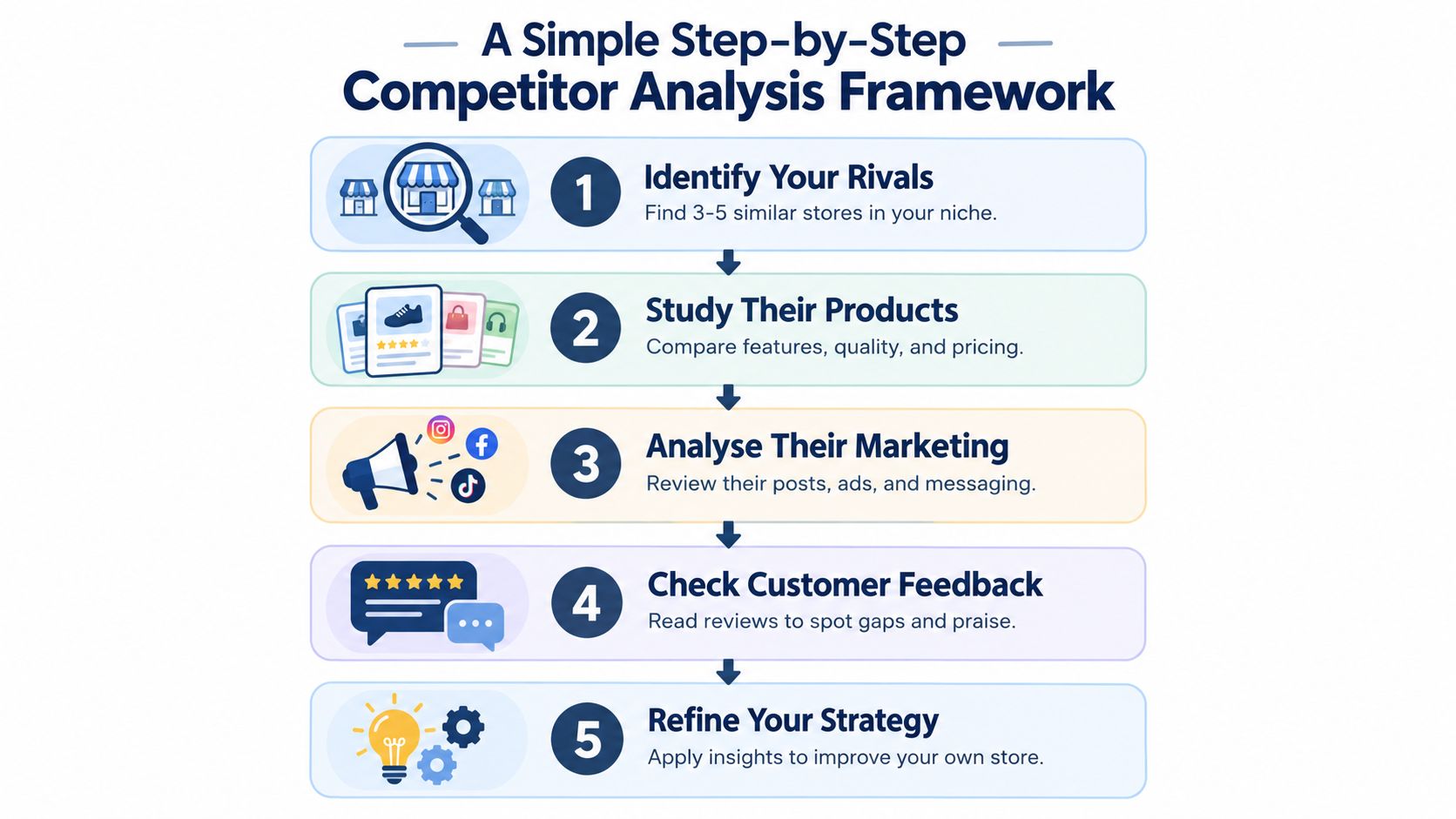
You can complete a useful first review in one sitting. Keep the list small. Start with three to five similar stores instead of trying to study every seller in South Africa.
Start with the right rivals
Search for the products you sell using plain words, such as “handmade beaded bracelets South Africa” or “custom earrings Cape Town”. Add sellers you already hear about from customers and markets. Separate them into:
- Direct competitors: They sell similar products to similar customers.
- Indirect competitors: They solve the same buying need with another product.
- Aspirational competitors: They show the level of presentation or service you'd like to reach.
Write down the store name, website, social profile, product type, and the reason you included it. This stops the list from becoming random.
Record what a shopper experiences
Open each store on your phone. Note how quickly you understand what it sells, who it's for, and what action you should take. Add observations to a basic spreadsheet with columns for product, price, materials, sizing, delivery, payment, returns, reviews, and contact options.
Then read customer comments. Don't only count positive ratings. Look for repeated words and frustrations. If shoppers keep asking about delivery dates, improve your delivery explanation. If they praise packaging, show your own packaging clearly.
For search ideas, use Google's autocomplete suggestions and related searches. You can also explore SpyFu alternatives from Keyword Kick if you want to compare accessible keyword research options without committing to one platform.
Turn notes into one decision
At the end, write three short statements:
- Customers seem to value: the repeated benefit you see in products and reviews.
- Competitors often overlook: the recurring complaint or missing detail.
- My store will be known for: one promise you can deliver.
That final line guides your product pages, social posts, packaging, and customer service. It also keeps research from becoming a hobby with no effect on sales.
Templates for Tracking Product Features and Pricing
A notebook works, but a simple spreadsheet makes side-by-side comparison easier. Use one row for each competitor and one column for each buying detail. Don't fill every cell with opinions. Record what a shopper can see.
| Area | Your store | Rival A | Rival B | What to ask |
|---|---|---|---|---|
| Main product | Your best-selling or planned item | Similar item | Alternative item | Do shoppers see the same use or occasion? |
| Materials | Materials and care details | What they disclose | What they disclose | Does the customer understand quality? |
| Price | Your current price | Listed price | Listed price | Are you comparing similar size and finish? |
| Delivery | Your stated process | Their promise | Their promise | Is timing clear before checkout? |
| Payment | Methods you offer | Methods shown | Methods shown | Can a local mobile shopper pay comfortably? |
| Marketing message | Your main promise | Their main promise | Their main promise | Which benefit appears most strongly? |
| Customer feedback | Your questions and reviews | Praise and complaints | Praise and complaints | What problem can you solve better? |
Add the details that affect trust
For handmade products, price alone can mislead you. A lower-priced necklace may use different materials, have no gift packaging, or take longer to dispatch. Compare like with like, then explain your own value in simple words.
Use a second page as an action checklist:
- Product page: Add missing measurements, material information, care instructions, and delivery expectations.
- Photos: Check whether shoppers can see scale, texture, clasp details, and the item being worn.
- Offer: Test a bundle, gift option, or custom choice only if it fits your production capacity.
- Message: Rewrite the first lines so customers understand who the product suits.
- Follow-up: Note how competitors encourage repeat purchases or seasonal gifting.
Your spreadsheet shouldn't tell you to copy a price blindly. It should show whether you're offering a different level of quality, convenience, or service.
If you're unsure how to calculate a sustainable price, use this practical guide on how to price handmade items. Your material costs, time, packaging, payment costs, and delivery handling all need a place in the decision.
Local Examples and Lessons from South African Makers
A Cape Town ceramicist notices that nearby shops promote mugs by colour and shape. Their photos look attractive, but product pages say little about capacity, care, or whether the mug is suitable as a gift. She adds those details, photographs the mug beside a familiar household object, and creates a small gift note option. Her advantage isn't a dramatic discount. It's removing questions that stop a hesitant shopper from buying.
A Gauteng clothing maker studies rival social posts and sees that most sellers show finished garments but rarely explain fit. She adds waist and length measurements, model information, and a short video showing movement. Customers now have more confidence before opening a WhatsApp chat. The lesson is simple. A competitor's missing information can become your selling point.
An KwaZulu-Natal gift seller takes a different route. She notices that competitors offer beautiful products but make customers search for delivery information and payment choices. She brings those details closer to the product description and checkout, then watches for questions that still come through direct messages. She isn't assuming that every customer wants the same thing. She's using real questions to improve the store.
South African online retail is expanding, but connected people don't automatically become online buyers. Internet access reaches 79.1% of South African adults, while only 34.2% shop online, and online-shopping penetration fell from 36.6% in 2024 to 34.2% in 2025, according to Mastercard's South Africa online shopping report. That gap points to a trust and ease problem, not only a product problem.
Watch the short video below for another practical visual reminder of how small businesses can present their work and learn from the market.
Location matters too. The largest SMME concentrations are in Gauteng at 30.7%, the Western Cape at 29.3%, and KwaZulu-Natal at 14.1%, according to reporting on SMME access to customers. If most of your orders come from one province, compare delivery promises and local buying habits there instead of relying on a national average.
Turning Research into Action on Your Shopstar Store
Your notes become useful when they change something a customer can see. Choose one or two findings first. A nervous beginner often tries to redesign the whole store, change every price, and join every social platform at once. That creates confusion and makes it hard to know what helped.
Improve the product page first
Suppose rival reviews repeatedly mention unclear sizing. Add a measurement guide, a fit note, and a clear answer near the purchase button. If shoppers praise another seller's material quality, explain your own materials with care instructions and close-up photos. If buyers want gifts, show the packaging and explain how you prepare it.
Use Shopstar as one practical option for putting these changes in place. Its no-code designer, ready-made themes, product management, inventory, orders, analytics, local payments, and shipping tools bring common store tasks into one dashboard. You can update product information without building the shop from scratch.
Make one positioning choice
Don't write “high quality” and leave it there. Choose a promise that your process supports:
- “Handmade gifts for meaningful milestones.”
- “Adjustable jewellery for easy everyday wear.”
- “Small-batch pieces inspired by South African colour.”
- “Personalised accessories, packed ready to give.”
Your promise should appear in your homepage opening, product descriptions, social captions, and customer messages. Consistency helps shoppers remember why they considered you.
Check the mobile buying journey
South African shoppers may discover you through Instagram, Facebook, Google, or WhatsApp. Open your own store on a phone and test the journey as if you've never seen it before. Can you understand the product, price, delivery, payment, and next step without asking for help?
The online retail market is projected to reach about R159-billion in 2026, with roughly 22.5% year-on-year growth and e-commerce at around 10% of national retail turnover, according to Mastercard's 2026 online retail release. A separate Peach Payments report says shoppers spent about R130-billion online in 2025, up from R96-billion the year before, and projects roughly R159-billion in 2026. Treat those figures as context for a changing market, not as a guarantee for your shop.
Payment choice deserves a close look. Sampled checkout data reported instant EFT or automated bank transfer at 16.4%, debit cards at 15.3%, saved card details at 10.6%, credit cards at 9.3%, and Capitec Pay at 9.1%, as shown in Mastercard's South African online retail report. Make the methods you support visible before the final step, and check whether payment failure or uncertainty is creating unnecessary friction.
Finally, publish content based on the questions your research uncovered. A jewellery store might create a page about choosing a bracelet size, a guide to caring for plated pieces, or a gift guide for local celebrations. Add clear product names and natural search phrases, then share the page through the channels your customers already use. For more practical selling ideas, follow this guide on how to improve sales.
Review your competitor notes regularly, but don't check rivals every day. Give each change enough time to collect customer responses, then keep what helps and remove what doesn't. The aim isn't to chase every competitor. It's to build a store that makes a clear promise and keeps it.
Shopstar gives South African makers the tools to launch and manage an online store, with local payments, shipping, inventory, orders, analytics, social selling, and human support in one place. Start applying your competitor analysis with a focused store, then visit Shopstar to explore the 14-day free trial and build your shop without a credit card.