Products That Are Eco Friendly in South Africa
October 2, 2026 · 16 min read · Dylan Klichowicz
You're standing at your kitchen table with bamboo toothbrushes, beeswax wraps and recycled notebooks spread around you. The online shop is almost ready, but one question keeps coming back: do these products really count as eco-friendly, or have you just placed a leaf on the packaging?
That question matters in South Africa. The country generated about 55 million tonnes of general waste in 2017, while only 11% was diverted from landfill, according to the National Waste Management Strategy information. For a new maker, sustainability isn't a vague lifestyle label. It affects what you source, how you package orders, what you can prove to customers and whether your product deserves a place in a buyer's budget.
Table of Contents
- What Eco-Friendly Products Actually Mean for a New South African Seller
- The Building Blocks That Make a Product Eco-Friendly
- Sourcing and Certification Tips for South African Makers
- Eco-Friendly Product Categories You Can Sell Online in South Africa
- The Price Question South African Buyers Are Asking
- Marketing and Positioning Your Eco-Friendly Store with Shopstar
What Eco-Friendly Products Actually Mean for a New South African Seller
Your online shop is ready to open, and a customer asks a simple question: “Why is this product eco-friendly?” You should be able to answer without relying on a leaf symbol, vague packaging or a supplier's broad promise.
An eco-friendly product is designed or sourced to reduce environmental harm across its life cycle. For a new South African maker, that means examining the material, how the item is made, how it reaches the buyer, how long it remains useful and what happens after use. The claim belongs to the whole journey, not one appealing ingredient.
A bamboo toothbrush shows why this matters. Bamboo may be renewable, yet the product still needs scrutiny. Can the bristles be removed from the handle? Has the toothbrush travelled a long distance to reach South Africa? Does it arrive in layers of plastic? These details affect what you can honestly promise local buyers.
Start with the full product journey
Run every possible product through this maker test before adding it to your catalogue:
- Raw materials: Is the main material recycled, renewable, responsibly sourced or reused?
- Making: Does production avoid unnecessary waste, harsh processes and excessive energy use?
- Useful life: Will customers use the item repeatedly, or replace it quickly?
- Delivery: Can you pack and send it without avoidable plastic or bulky materials?
- End-of-life: Can customers reuse, repair, recycle, compost or safely dispose of it?
A refillable cleaning container may reduce packaging whenever a buyer orders concentrate. An upcycled fabric tote gives existing material another useful purpose. A biodegradable cleaning block may avoid plastic packaging, but you need evidence for that claim and clear disposal instructions. If you cannot answer those questions, ask the supplier before listing the product.
A practical definition: An eco-friendly product meets a real customer need while creating less environmental pressure than a realistic conventional alternative.
South African buyers often look for visible results in everyday life. They may want less household waste, packaging that does not become another disposal problem and products suited to local homes. Recycling and disposal options can differ by area, so the overview of recycling in South Africa provides useful background when you explain what customers can do after use.
Make your product page as clear as your sourcing notes. State what the customer receives, identify the relevant materials, explain how to use the item and describe how long it should last. For clothing, accessories and textile goods, smarter buying with ClothME fit tips can help customers choose pieces they will wear for longer instead of replacing them quickly.
Your first online range does not need to solve every environmental problem. Choose products whose materials, maker, packaging and end-of-life path you can explain. Specific evidence gives your store more credibility than calling everything “green.”
The Building Blocks That Make a Product Eco-Friendly
Think of an eco-friendly product like a well-built house. Good bricks don't help much if the roof leaks, and recycled material doesn't make a product responsible if it breaks immediately or arrives wrapped in unnecessary plastic.
Materials are the starting point
Materials are the ingredients of your product. Choosing organic cotton over conventional cotton can be compared with choosing free-range eggs. The comparison doesn't mean the materials are identical. It means the starting choice affects the story and the impact of the finished item.
Ask your supplier whether the material is recycled, certified, reclaimed, renewable or merely described with a vague word such as “natural”. A natural ingredient can still be over-packaged, difficult to source responsibly or unsuitable for local disposal.
Production changes the picture
Two makers can produce a similar item with different environmental footprints. A small studio using careful batch production may create less waste than a factory making excess stock, while production powered by renewable energy may have a different impact from production relying heavily on fossil fuels.
South Africa's plastics life-cycle assessment estimated that the sector emitted 15.8 Mt CO2eq in 2015, with granulate production carrying the highest environmental load. The same South African plastics assessment found recycling saved about 1.4 Mt of greenhouse-gas emissions that year. For a maker, the lesson is straightforward: recycled inputs can matter, but you should know what percentage of your material is recycled and whether the claim is documented.
Durability is an environmental feature
A cast-iron pan that serves a household for years is a different proposition from a cheap non-stick pan that flakes and needs replacing quickly. A reusable water bottle, cloth napkin or fabric shopping bag only reduces waste if the customer can keep using it.
Describe the stitching, thickness, care instructions, refill options and repair possibilities. Durability also protects your customer from paying twice for the same job.
Packaging and transport need their own check
Use the smallest protective package that keeps the order safe. Shredded cardboard, paper tape, reused boxes and a plain mailer can often do the job without turning delivery into a second product.
Transport matters because a product's journey doesn't stop at your workbench. Grouping stock from local suppliers, avoiding unnecessary imported components and sending combined orders can reduce handling and packaging, even when you can't eliminate courier travel.
End-of-life closes the loop
Tell the buyer what to do when the item is worn out. A glass jar may be reused, paper may enter an established recycling stream and a textile item may be repaired or turned into another product. “Compostable” isn't a magic word if the buyer doesn't know what conditions are needed or whether the local system can handle it.
South Africa's packaging evidence shows why design choices matter. The SA Plastics Pact baseline report recorded that 80.7% of plastic packaging placed on the market by members was recyclable in South Africa, while members saved 43,800 tonnes of virgin plastics in 2020. Before listing an item, score each building block as strong, unclear or weak. One weak point doesn't always reject the product, but it tells you what to improve or explain.
Sourcing and Certification Tips for South African Makers
Walk through a market in Cape Town, Johannesburg or Durban with a notebook, not only a shopping bag. Look at the seller's materials, ask where the components come from and record names of local suppliers who can provide consistent stock.
A small maker could source recycled paper from a local mill, organic textiles from a fabric wholesaler or natural ingredients from a supplier willing to share technical information. Buying locally can also make it easier to inspect samples, resolve quality problems and tell a truthful maker story.
Build a supplier evidence folder
Don't rely on a supplier's product title. Ask for documents before you make an environmental claim.
- Request proof: Ask for certification documents, recycled-content information and clear material descriptions.
- Check safety information: Request material safety data sheets for relevant ingredients and products.
- Photograph records: Keep photographs or scans of certificates, labels and supplier packaging.
- Match evidence to stock: Save everything in one folder linked to the product name in your online shop.
- Review dates: Check whether documents are current before you repeat a claim in a new product launch.
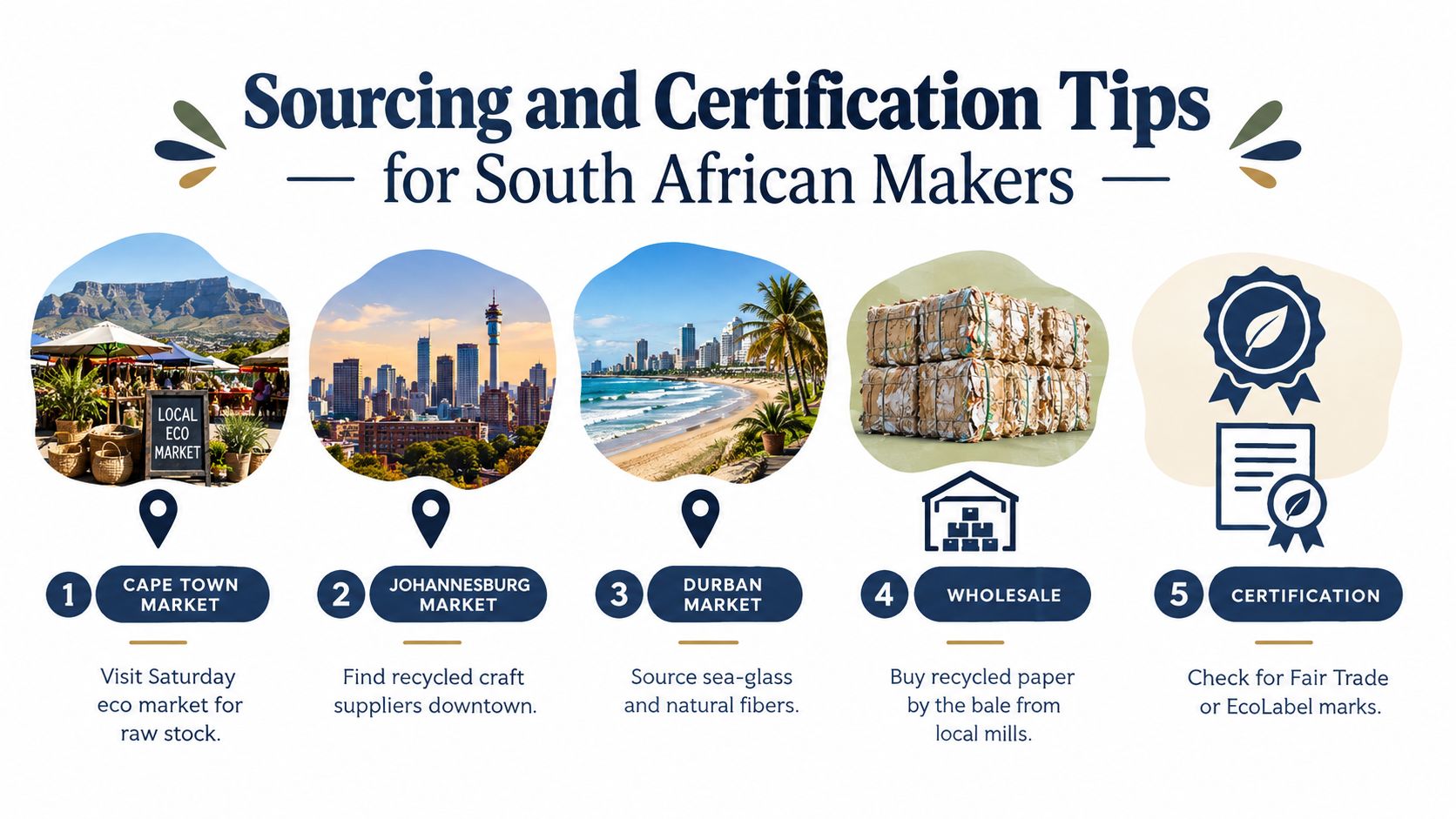
You may come across labels such as ECOCert, the Forest Stewardship Council mark for wood and paper, or the Proudly South African stamp used by local producers. Treat a label as a starting point for checking, not as a substitute for understanding what it covers. Confirm the licence, scope and product connection before placing the mark on your own product page.
Packaging deserves the same care as the item inside. A compostable mailer may suit some products, while shredded cardboard, paper tape and an unbranded box may be more practical for others. Do not choose a package just because it sounds sustainable. Check whether it protects the item, whether your customer knows how to dispose of it and whether the claim is supported.
South African rules are particularly important for packaging language. The DFFE packaging recyclability guideline states that products claiming to be biodegradable, compostable or oxo-biodegradable must conform to appropriate international standards, with claims verified by accredited laboratories and supported by technical data.
You'll also need to understand Extended Producer Responsibility. The EPR compliance checklist for packaging design explains that producers must register with the DFFE, join a registered Producer Responsibility Organisation or operate a compliant scheme, and fund post-consumer management for products placed on the market. Use an Ovenbell compliance directory to organise compliance research, then confirm requirements with the relevant authority or adviser.
If you're comparing private-label options, this guide to white-label product manufacturers can help you think through what the supplier makes, what you control and which claims you'll need to verify yourself.
Eco-Friendly Product Categories You Can Sell Online in South Africa
A Saturday market stall gives you a useful way to judge beginner products. Pick up a beeswax wrap and you can feel its texture. Open a recycled notebook and inspect the paper. Ask the maker how the item was produced, then notice which answers would help a customer decide online.
Here are seven categories that can work for a small South African shop when the maker can source reliably and describe the evidence clearly.
| Category | Key eco-friendly feature | Typical ZA price band | Suitability for ZA courier shipping |
|---|---|---|---|
| Reusable beeswax wraps | Reusable food covering that replaces disposable wrap | Accessible to mid-range | Light and easy to send |
| Bamboo kitchen and bathroom swaps | Reusable or lower-plastic alternatives for daily routines | Accessible to mid-range | Light, but protect delicate parts |
| Refillable cleaning concentrates | Concentrate supplied for reuse in an existing bottle | Mid-range, depending on refill system | Good if leak-proof and shelf-stable |
| Natural skincare bars | Solid format with reduced packaging and carefully listed ingredients | Mid-range to premium | Strong, if protected from heat |
| Upcycled textile goods | Existing fabric turned into bags, pouches or accessories | Varies by labour and material | Light and flexible |
| Compostable pet accessories | Products designed to reduce persistent waste where claims are proven | Mid-range to premium | Good for small, durable items |
| Recycled-paper stationery | Paper goods made with recycled inputs and simple packaging | Accessible to mid-range | Excellent for flat, light orders |
Beeswax wraps and bamboo swaps are easy to demonstrate in short videos. Show the wrap around a bowl, explain cleaning and storage, and state what material the customer receives. Don't call a bamboo item compostable if its glue, coating or other parts prevent that outcome.
Refillable cleaning concentrates create a useful repeat-purchase model, but your listing must cover dilution, storage, ingredients and the bottle the customer needs. Natural skincare bars need equally careful descriptions. “Natural” doesn't automatically tell a buyer whether the product suits their skin, how it was made or how it should be stored.
Upcycled textiles give you a strong maker story because each item can have a visible past. Recycled-paper stationery is practical for bundles, gifts and corporate orders. Compostable pet accessories may appeal to values-led buyers, but disposal instructions and substantiated claims are essential.
Product filter: Before ordering stock, ask whether the item is light, unbreakable, shelf-stable and simple to explain in one product photo caption.
These categories can travel well through national courier networks, especially when you avoid unnecessary glass, liquids and bulky packaging. For guidance on presenting a new collection, use this creator product launch strategy, and explore the practical steps in how to start an online thrift store in South Africa if upcycling becomes your main direction.
The Price Question South African Buyers Are Asking
A customer sees a beeswax wrap next to cling film and asks why the reusable option costs more. That isn't an attack on your business. South African households are balancing food, fuel and electricity costs, so an eco-friendly item must earn its place in the basket.
Recent South African survey reporting shows the tension clearly. 66% of consumers perceive eco-friendly products as more expensive, 64% say they're willing to pay more, and 52% still prioritise cost over environmental impact, according to The Green Agenda's coverage of South African consumer attitudes. The same reporting says 55% think recycling is too much effort, which means convenience can matter as much as environmental intention.
Sell the value without making promises you can't prove
Don't tell customers that a higher price is automatically justified because a product is green. Explain what they receive and what they may stop buying.
A beeswax wrap may cost more upfront because the maker is paying for material, careful production and reusable construction. The relevant comparison isn't only the first till price. It also includes how often the customer replaces the disposable alternative, whether the reusable item can be cleaned and whether the buyer wants that routine.
Use plain language in your product description:
- Durability: “Made for repeated use. Follow the care instructions to help extend its useful life.”
- Material: “Made with the materials listed below. We've included supplier information where available.”
- Local value: “Produced by a South African maker,” if you can substantiate that statement.
- Packaging: “Packed in paper-based materials,” only if that accurately describes the order.
- Honest limits: “This product reduces single-use packaging, but its components should be disposed of separately.”
Don't claim “zero waste”, “non-toxic” or “fully sustainable” unless you can define and support the wording. Buyers are more likely to trust a product page that admits what the item does and doesn't solve.
A useful pricing exercise is to list the material cost, labour, packaging, payment costs, delivery contribution and profit you need. The guide to pricing handmade items can help you set a price that supports the business instead of forcing you to underpay yourself. Your goal isn't to win every comparison with cling film. It's to help the right buyer understand why the product fits their routine.
Marketing and Positioning Your Eco-Friendly Store with Shopstar
Your sustainability message should appear where a shopper makes a decision, not only on an About page. A customer should understand the product's material, use and disposal instructions before adding it to the basket.
Use six practical moves to make that information easy to find:
- Lead with one clear promise: Place a specific statement above the fold, such as “Reusable kitchen goods made in small batches”, if that accurately describes your range.
- Name the material early: Put “recycled paper”, “upcycled denim” or “refill concentrate” in the first product caption instead of hiding it below a long description.
- Create useful collections: Let customers browse by terms such as reusable, refillable, upcycled or plastic-reduced. Only use a filter when the products genuinely meet that description.
- Add a maker story block: Explain who makes the products, where the materials come from and what happens to offcuts or excess stock.
- Reward combined orders: Configure shipping so customers can understand when combining items may reduce delivery cost or packaging.
- Follow up thoughtfully: Use email tools for care instructions, refill reminders and repair guidance rather than sending constant discount messages.
A good product page answers the questions a cautious buyer is already asking. What is it made from? How do I use it? How long should it last? What do I do with it afterwards? Can you prove the environmental claim?
Shopstar is a South African ecommerce platform with a drag-and-drop store designer, ready-made themes, local payments, shipping, inventory and analytics in one dashboard. It also supports selling through channels such as Google, Instagram, Facebook and WhatsApp, which gives a small maker more places to explain a product without building separate systems.
Keep your claims specific. “Refill pouch for this cleaning concentrate” tells the shopper more than “planet-friendly cleaning”. “Upcycled cotton pouch, made from recovered fabric” gives a clearer reason to believe the product story, provided you can support it.
The strongest eco-friendly stores don't place a leaf icon on every listing and stop there. They build trust one honest product page at a time, show the trade-offs, explain the customer's role and make the greener choice easy to understand.
Shopstar gives you the tools to build a local online store with design, payments, shipping, inventory and marketing features suited to a small maker. Start shaping your eco-friendly range and visit Shopstar to explore the platform for your first shop.