Direct to Consumer Sales Guide for South African Makers
September 21, 2026 · 17 min read · Bronwyn Furno
You've probably had this thought already. You make something good, people like it at markets or on Instagram, and then sales go quiet because every order still depends on you posting again, replying again, and chasing attention again.
That's where direct to consumer sales starts to matter. Instead of waiting for a retailer, a stockist, or a marketplace to carry your business, you build a simple online store where people can buy from you directly. You control the product pages, the story, the follow-up, and the repeat sale.
For South African makers, that shift isn't just trendy. It's practical. Buyers are already comfortable shopping online, but the stores that win usually aren't the ones doing the most shouting. They're the ones that make it easy to discover the product, easy to buy on a phone, and easy to come back later.
Table of Contents
- Why Direct to Consumer Sales Makes Sense Right Now in South Africa
- How Direct to Consumer Sales Works and How Customers Find You
- Build Your Online Store on Shopstar Without Coding
- Connect Instagram WhatsApp Google and Marketplaces the Smart Way
- Measure What Matters and Fix Your Mobile Checkout First
- Scale Your Store and Avoid Common Beginner Mistakes
Why Direct to Consumer Sales Makes Sense Right Now in South Africa
A lot of beginners think direct to consumer sales means going fully alone and trying to beat big stores at everything. That's not what it means in real life.
If you sell handmade jewellery in Durbanville, small-batch sauces in Gqeberha, or ceramics in Joburg, direct to consumer sales means this. A customer can buy straight from your online store instead of only finding you through someone else's shelf, stall, or app.
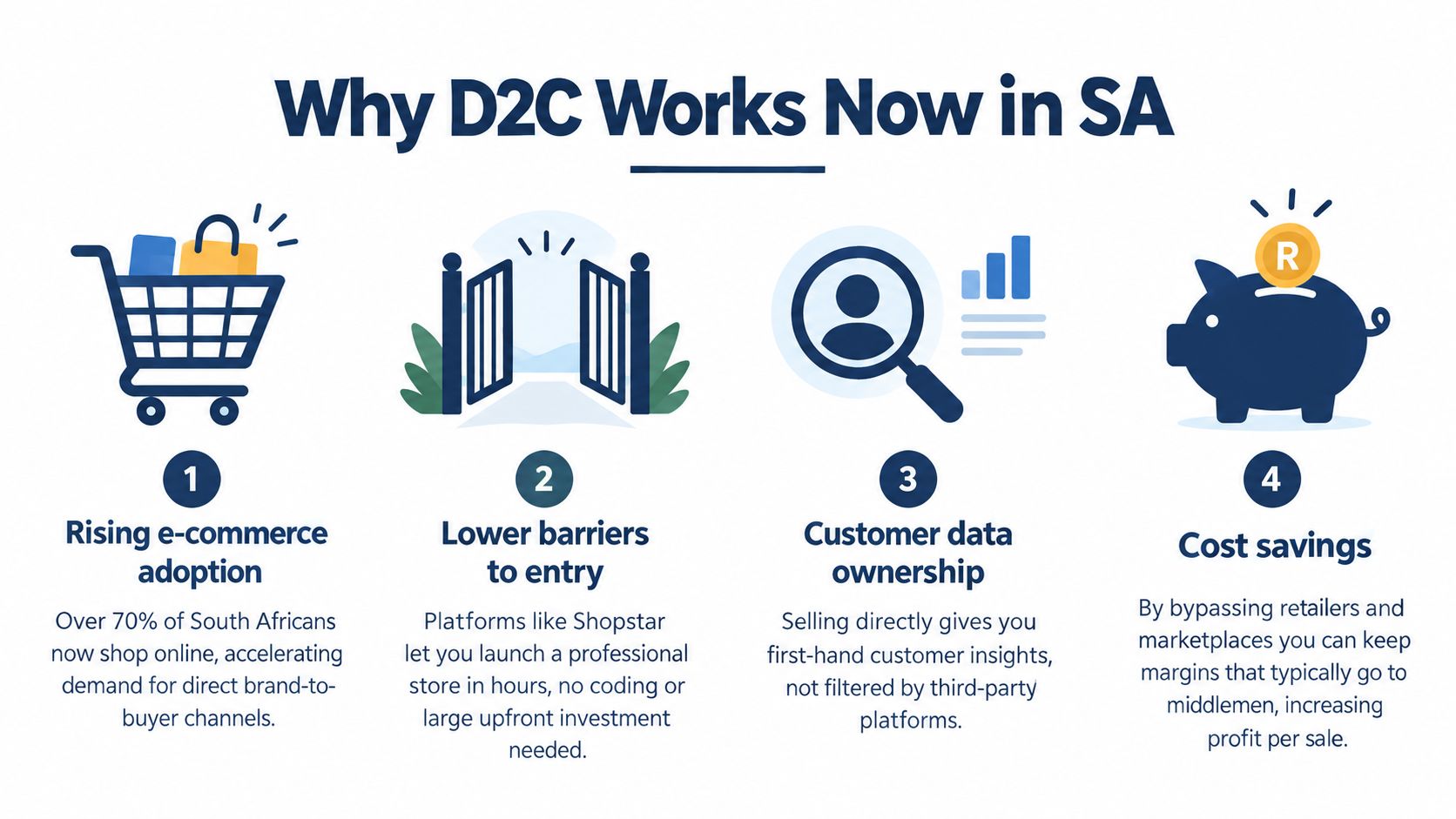
The timing is strong because online buying in South Africa has moved well past the early stage. South Africa's online retail market grew by about 35% in 2024 to an estimated R96-billion, and it was projected to reach about R159-billion in 2026, which would put online retail at roughly 10% of total retail sales according to Mastercard's South Africa online retail figures. For a small brand, that matters because online demand is no longer a side bet.
What you own when you sell direct
When you sell through a third party, you usually get the sale but not the full relationship. The buyer remembers the platform first. Your product sits next to many others. Price becomes the easiest thing to compare.
With a direct store, you own more of the important parts:
- Your brand story. You decide how the product is presented, photographed, and described.
- Your customer relationship. You can follow up after delivery, suggest a refill, or launch a new collection to past buyers.
- Your margin decisions. You choose bundles, gifts, shipping offers, and pricing structure based on your business.
- Your repeat sales path. A first order doesn't have to be the end of the relationship.
Why this matters more now than before
The older view was that online selling was experimental. That's not the environment anymore. Measured e-commerce sales in South Africa rose from R37.4-billion in 2018 to R86.8-billion in 2022, with e-commerce's share of total sales growing from 3.9% to 7.7%, according to Stats SA's e-commerce release. That tells you people didn't just try online buying once. They built it into normal shopping behaviour.
Practical rule: If people already want to buy online, your job isn't to convince the whole country. Your job is to make your store clear, trustworthy, and easy to use.
If you need inspiration from local sellers already doing this, browse South African store examples and case studies. Seeing real stores helps beginners realise that a clean, focused shop usually beats a complicated one.
How Direct to Consumer Sales Works and How Customers Find You
Direct to consumer sales is easier to understand when you follow one shopper.
Say someone sees a pair of handmade earrings on Instagram. They tap through to your store, check the price, zoom in on the photos, read your delivery info, and buy on their phone. A few days later, they get the parcel, like the quality, and message you on WhatsApp to ask whether you have a matching necklace. That's the full loop. Discovery, visit, purchase, delivery, repeat.
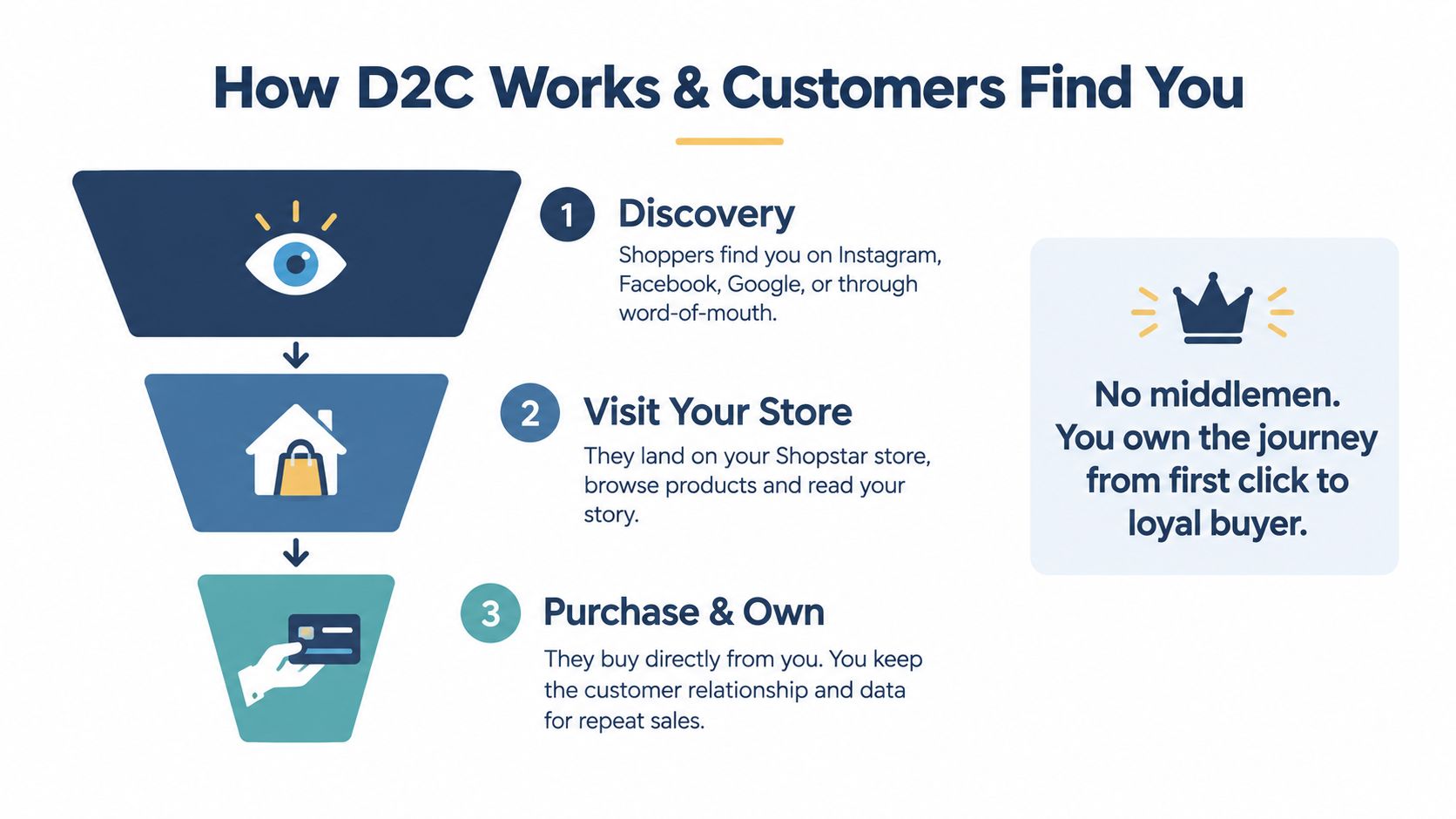
The simple customer journey
Most beginner stores need to think about four moments.
-
Discovery
People first hear about you somewhere else. That could be Instagram, Facebook, Google Search, a market, or a friend. -
Consideration
They check whether your store looks real and whether the product feels worth the money. Photos, product descriptions, delivery details, and your story do the heavy lifting. -
Purchase
They decide whether the checkout feels safe and easy enough to finish, especially on mobile. -
Repeat
They come back because the product was good, the delivery was smooth, and it's easy to find you again.
What to own at each step
A lot of new sellers focus only on the first step. They work hard to get attention, then send people to a weak product page or a clumsy checkout. That's where sales leak.
Here's what you should own in practice:
- At discovery. Keep your message tight. Don't post everything. A jewellery brand should lead with style, gifting, and detail shots. A ceramic seller should show scale, texture, and everyday use.
- At the store visit. Make sure each product page answers obvious questions. What is it made from? How big is it? Is it ready to ship or made to order?
- At purchase. Remove doubt. Show delivery timing, payment options, and return basics clearly.
- After delivery. Keep the buyer close. Send care tips, restock alerts, or matching-product suggestions.
Owning the store means owning the data and the repeat sale, not just the first click.
Real examples for small South African brands
A food maker has a different path from a fashion seller.
A chilli sauce brand often wins with bundles, refill orders, and gift packs. A ceramics brand often wins with story, craftsmanship, and a smaller range presented well. A jewellery store usually needs stronger product photography than almost anything else because buyers can't touch the piece.
That's why direct to consumer sales isn't one formula. The model stays the same, but the customer journey changes by product type. What doesn't change is this. People need an easy path from “that looks nice” to “I've paid”.
Build Your Online Store on Shopstar Without Coding
Most beginners don't need a custom-built website. They need a clean store, clear product pages, working payments, and a layout that looks good on a phone.
That's why a no-code setup makes sense at the start. You can build the store without getting stuck in technical jobs that don't bring in sales.
Start with the basics that customers actually notice
A store doesn't need to be fancy. It needs to answer the buyer's first questions fast.
Use this order when setting things up:
- Choose a simple store name. If your brand is already known on Instagram or at markets, keep the same name online.
- Pick a clean theme. Don't choose a layout with too many moving parts. Product-first themes usually work better for makers.
- Add your core products first. Start with your best sellers or your clearest range. Too many weak listings make a store feel unfinished.
- Use plain descriptions. Say what it is, who it's for, what it's made from, and what the buyer should know before ordering.
- Create useful collections. Group products by type, occasion, or price range so people don't have to hunt.
One practical option for this is Shopstar, which gives South African sellers a no-code store builder with built-in payments, shipping, orders, and inventory in one dashboard. If you want to see how the design side works before launching, have a look at the drag-and-drop website builder overview.
Build for the phone first
Mobile isn't a side issue in South Africa. A 2026 market study said smartphones accounted for 71.42% of the market's device share in 2025, according to Mordor Intelligence's South Africa ecommerce market report. That means your store should be checked on an actual phone before you worry about desktop polish.
Look at these basics on mobile:
- Photo order. Your first image must explain the product instantly.
- Button visibility. Add to cart and checkout buttons must be easy to tap.
- Text length. Huge paragraphs push the useful details too far down.
- Trust details. Delivery info, payment options, and contact details should be easy to spot.
A strong beginner store usually has fewer distractions, fewer pop-ups, and fewer menu options.
Add support before you add complexity
Once the store is live, you can make it easier for hesitant buyers to ask questions. If your products need explanation, sizing help, or custom options, chat can help close that gap. For stores that want to test conversational support, this guide on how to boost sales with chatbots is useful because it shows where chat can help and where it can become noise.
This walkthrough gives a good sense of what a simple setup looks like in practice.
Keep your launch lean
Beginners often delay launch because they think every page must be perfect. It doesn't.
A lean launch usually needs:
- A homepage with a clear offer
- Product pages with good photos
- Working payments
- Delivery information
- A contact method
- Basic policies
The stores that get traction fastest are often the ones that launch tidy, learn from real buyers, and improve every week.
Connect Instagram WhatsApp Google and Marketplaces the Smart Way
A direct store shouldn't sit alone and hope people find it. South African shoppers already spend time on social platforms, search on Google, and buy on marketplaces. The smart move is to use those channels for discovery while keeping your own store as the place where the brand relationship deepens.
That's the hybrid model. Not pure marketplace. Not store-only. Both, with different jobs.
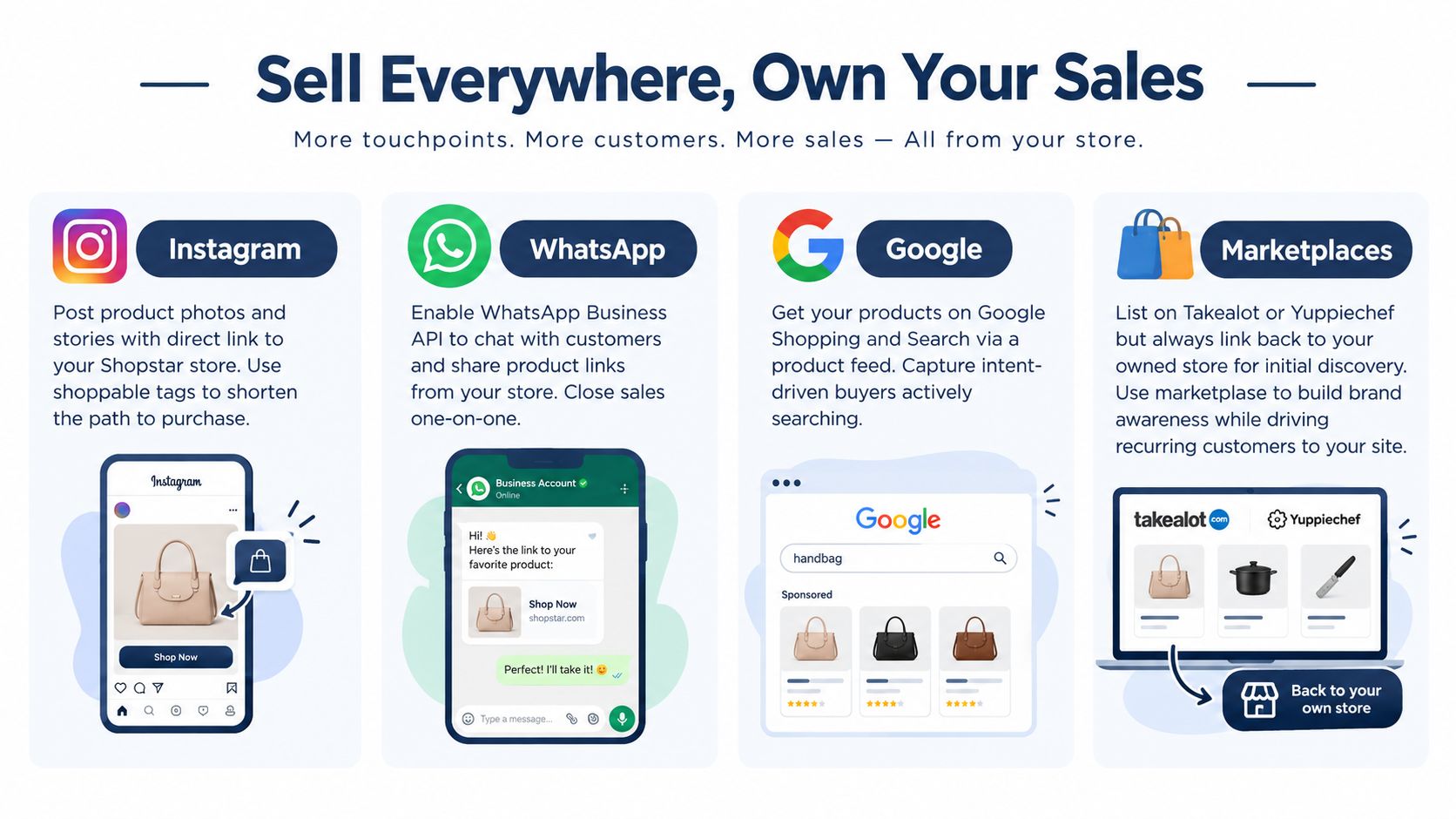
What each channel is good for
Some channels are better at discovery. Others are better at conversion or repeat buying.
Here's a practical comparison:
| Channel | Best use | Watch-out |
|---|---|---|
| Visual discovery and product interest | Attention is rented. People scroll away fast | |
| Questions, custom orders, updates, repeat buying | Hard to manage if every order is manual | |
| Capturing buyers with clear intent | Product pages must match the search | |
| Marketplaces | Reach and trust for first-time buyers | Your brand can get flattened into a price comparison |
| Your store | Brand control, full catalogue, repeat sales | You still need traffic sources |
Why marketplaces matter, but not on their own
A lot of local D2C advice skips an awkward truth. South Africans do use marketplaces heavily. A South Africa report cited by The Media Online's coverage of the online retail market says 99% of shoppers buy from marketplaces, with Takealot used by 92%, Temu by 60%, and Shein by 54%. That doesn't mean you should give marketplaces your whole business. It means you should treat them as discovery channels where relevant.
For many makers, the better question is not “Should I avoid marketplaces?” It's “How do I use them without losing the customer relationship?”
If a marketplace helps a buyer discover you, that's useful. If it becomes the only place people can remember you, that's a problem.
A practical hybrid channel plan
Keep the system simple at the start.
- Use Instagram for attention. Post real product photos, behind-the-scenes making, and customer use cases. Link directly to product pages, not just the homepage.
- Use WhatsApp for reassurance. Let buyers ask about stock, lead time, gifting, and delivery. Keep replies clear and short.
- Use Google for high-intent searches. Make sure product titles and descriptions match what people search for.
- Use marketplaces selectively. List products that are easy to understand, easy to ship, and good at pulling new people into your brand orbit.
If you want a local overview of how social selling fits into this mix, the social ecommerce guide for South African sellers is a practical starting point.
The mistake to avoid is spreading yourself too thin. It's better to run three channels properly than six channels badly.
Measure What Matters and Fix Your Mobile Checkout First
Most beginners think slow sales mean they need more traffic. Sometimes they do. Often they don't.
A weak funnel can waste good traffic all day. In South Africa, ecommerce stores average roughly 1.5% purchase conversion, which is about 15 purchases per 1,000 visitors, and broader local benchmarks still sit around 1% to 3%, with 2%+ being a strong target for established stores according to South African conversion rate benchmarks. The same source reports cart abandonment at about 83% to 83.5%. That tells you where many stores lose intent.
Diagnose the funnel in the right order
Don't start by changing everything at once. Check the funnel in sequence.
-
Traffic quality
Are the right people landing on the store, or are you attracting curious browsers who were never likely to buy? -
Product-page persuasion
Do the photos, descriptions, pricing, and delivery details help a shopper decide? -
Checkout friction
Is the path from cart to payment smooth on a phone? -
Payment trust
Do people feel safe enough to complete the order?
Here's a simple way to review it.
| Funnel Stage | What to Check | Healthy Target |
|---|---|---|
| Traffic quality | Whether visitors match the product and price point | Relevant visitors who browse product pages, not random clicks |
| Product page | Clear photos, plain descriptions, visible delivery info | Enough clarity that shoppers add to cart without needing to ask basic questions |
| Checkout | Mobile speed, form length, easy payment flow | Smooth completion on a phone with minimal drop-off |
| Purchase conversion | Final sales rate from total visits | Around 1% to 3% in South Africa, with 2%+ strong for established stores |
| Cart completion | Drop-off between cart and payment | Better than the high abandonment levels many stores struggle with |
Fix the phone experience before buying more traffic
A South African e-commerce update reported that 72% of all online orders in Q3 2025 came from mobile transactions, according to Shiprazor's ecommerce logistics update. That doesn't guarantee your own store follows the exact same mix, but it's a strong warning. If checkout feels clumsy on a phone, more traffic just means more people dropping off.
Good fixes are usually unglamorous:
- Show delivery costs early
- Keep checkout fields minimal
- Offer familiar payment methods
- Make buttons large enough to tap
- Keep trust signals visible near checkout
Check this first: Open your own store on your phone, add a product to cart, and try to pay. Most problems reveal themselves in two minutes.
Use free shipping carefully
Free shipping can help, but only when the threshold is set properly. A South African ecommerce guide reports that setting a free-shipping threshold above a basket threshold commonly increases orders by 30% to 45% in local Shopify stores, and recommends placing the threshold at about 1.5x average order value, according to Raimond's South Africa ecommerce guide.
The trade-off matters.
- Too low, and you may lift conversion while cutting into margin.
- Too high, and shoppers ignore the offer.
- Just above normal basket size, and it can nudge buyers to add one more item.
Watch both conversion and margin after you launch the offer. More orders only help if the business still works.
Scale Your Store and Avoid Common Beginner Mistakes
Once the first orders come in, the work changes. You're no longer proving that people will buy. You're building a system that can keep selling without draining all your time.
The strongest small stores usually scale by becoming more organised, not by becoming more complicated.
What to tighten as you grow
A few improvements make a real difference:
- Automate the routine bits. Order confirmations, shipping updates, and simple follow-up messages save time and reduce customer anxiety.
- Add products carefully. Expand from what already sells. Don't flood the store with weak extras just to look bigger.
- Nurture repeat buyers. Email and WhatsApp work well for restocks, launches, and seasonal gift reminders when used sensibly.
- Keep pricing transparent. Hidden fees and fuzzy delivery costs create distrust fast.
- Review delivery operations early. If you're handling your own fulfilment or local drops, this guide to last mile delivery is worth reading because delivery experience often shapes whether a buyer orders again.
Common mistakes that slow new stores down
The most common beginner errors are usually fixable.
- Buying traffic before fixing checkout. If people are dropping at payment, ads won't solve the issue.
- Setting the free-shipping threshold badly. Too low hurts margin. Too high gets ignored.
- Ignoring delivery expectations. Buyers want clarity on timing, costs, and updates.
- Writing for yourself instead of the customer. Product pages should answer buyer questions, not just describe your creative process.
- Trying every channel at once. Too many half-managed channels lead to confusion and missed messages.
Small wins compound. A cleaner checkout, faster replies, clearer delivery info, and better post-purchase follow-up usually do more than another burst of random promotion.
If you started this article feeling stuck between marketplaces, social selling, and building your own site, the practical answer is usually a hybrid path. Let discovery happen where buyers already spend time. Then make your store the place where trust, repeat buying, and brand value grow.
If you're ready to set up direct to consumer sales properly, Shopstar gives South African makers a way to build an online store without coding, with local payments, shipping, orders, and inventory in one place. It's a practical option if you want to move from scattered orders to a proper store that can support repeat customers and steady growth.