How to Make Candles to Sell a South African Makers Guide
September 18, 2026 · 16 min read · Hannah Furno
You've poured a few candles on the kitchen counter, admired the creamy finish, and started wondering whether someone would pay for them. That question changes the whole process. A candle for your own lounge can be slightly uneven, but a candle sold online must arrive looking professional, burn predictably, smell pleasant and match the product description.
South Africa has a useful history behind this shift. Candles were once a regular lighting necessity, but the share of households using candles as their main lighting source fell from 28.8% in 1996 to 3.2% in 2022, while household electricity access rose from 58.1% to 94.7%, according to Statistics South Africa's Stats in Brief 2025. That doesn't mean candles have disappeared. It means buyers now choose them mainly for décor, gifting, fragrance, self-care and emergency use.
A maker who knows how to make candles to sell therefore needs more than a pleasant scent and a pretty jar. You need a repeatable formula, a tested wick, honest labelling, sensible pricing and a simple way for customers to place orders. This guide takes you from your first supply purchase to a small online store on Shopstar, without burying you in technical language.
Table of Contents
- Introduction to Making Candles You Can Actually Sell
- What You Need Before You Pour Your First Sellable Candle
- How to Make Candles to Sell With a Repeatable Method
- Pricing Safety and Legal Must Knows for South Africa
- Branding Packaging and Launching Your Candle Store on Shopstar
- Practical Tips to Sell More and Keep Customers Coming Back
Introduction to Making Candles You Can Actually Sell
A beginner often starts with one attractive idea, perhaps a vanilla jar, a colourful mould or a candle shaped like a flower. The first pour looks promising. Then the second candle has a sinkhole, the third burns with a tall smoky flame and the fourth smells much weaker than the first. That's normal during learning, but those results shouldn't go straight into an online shop.
A sellable candle is a finished product that performs consistently. It has a stable wick, a clean surface, a suitable fragrance load, secure packaging and a label that tells the customer what they're buying. The wax matters, but it's only one part of the finished unit.
From household necessity to lifestyle product
South Africa's electrification history gives candle makers a clear positioning lesson. As everyday lighting dependence declined, candles moved into more discretionary categories. A buyer may want a calming bedroom scent, a hostess gift, a wedding favour, a decorative centrepiece or a small product for load-shedding preparation.
That creates room for different businesses. One maker might focus on understated soy candles for home décor. Another might sell bold gift boxes, locally inspired scent names or small event orders. The important point is to choose a customer and occasion before buying a cupboard full of fragrance oils.
Practical rule: Don't build a range around every scent you personally like. Build it around a clear reason for someone to buy.
What customers notice first
Online shoppers can't pick up your jar or smell the wax through their phone. They judge your product through photographs, wording, reviews, packaging and the confidence of your listing. A candle that looks handmade in a careful, intentional way can attract attention. A candle with a crooked wick, blurry photograph or vague safety information creates doubt.
Treat your first batch as product development rather than guaranteed stock. Make a small set, record the materials and test the finished candles. Test whether they smoke, drip, tunnel, flare or lose their scent quickly. The South African standard discussed in NWU's research on candle requirements makes the same practical point: the candle sold to the customer must be assessed as a complete retail unit.
Your first objective isn't to have a huge catalogue. It's to produce one candle you can make again, photograph clearly, price properly and send with confidence.
What You Need Before You Pour Your First Sellable Candle
Buy less, but buy deliberately. Many new makers waste money on unusual moulds, large fragrance collections and decorative packaging before they know whether their wax and wick combination works. Start with one container style, a manageable wax option and a small group of scents.
Soy wax is a strong starting point for makers who want a smooth container candle and a familiar plant-based selling story. A South African market outlook identifies soy wax as the largest revenue-generating product type, while beeswax is described as the fastest-growing material segment in its forecast. You can compare those material insights in the South Africa candle market outlook from Grand View Research. Paraffin remains another practical option, especially where cost, colour and strong scent performance matter, but your choice should match your customer and your testing ability.
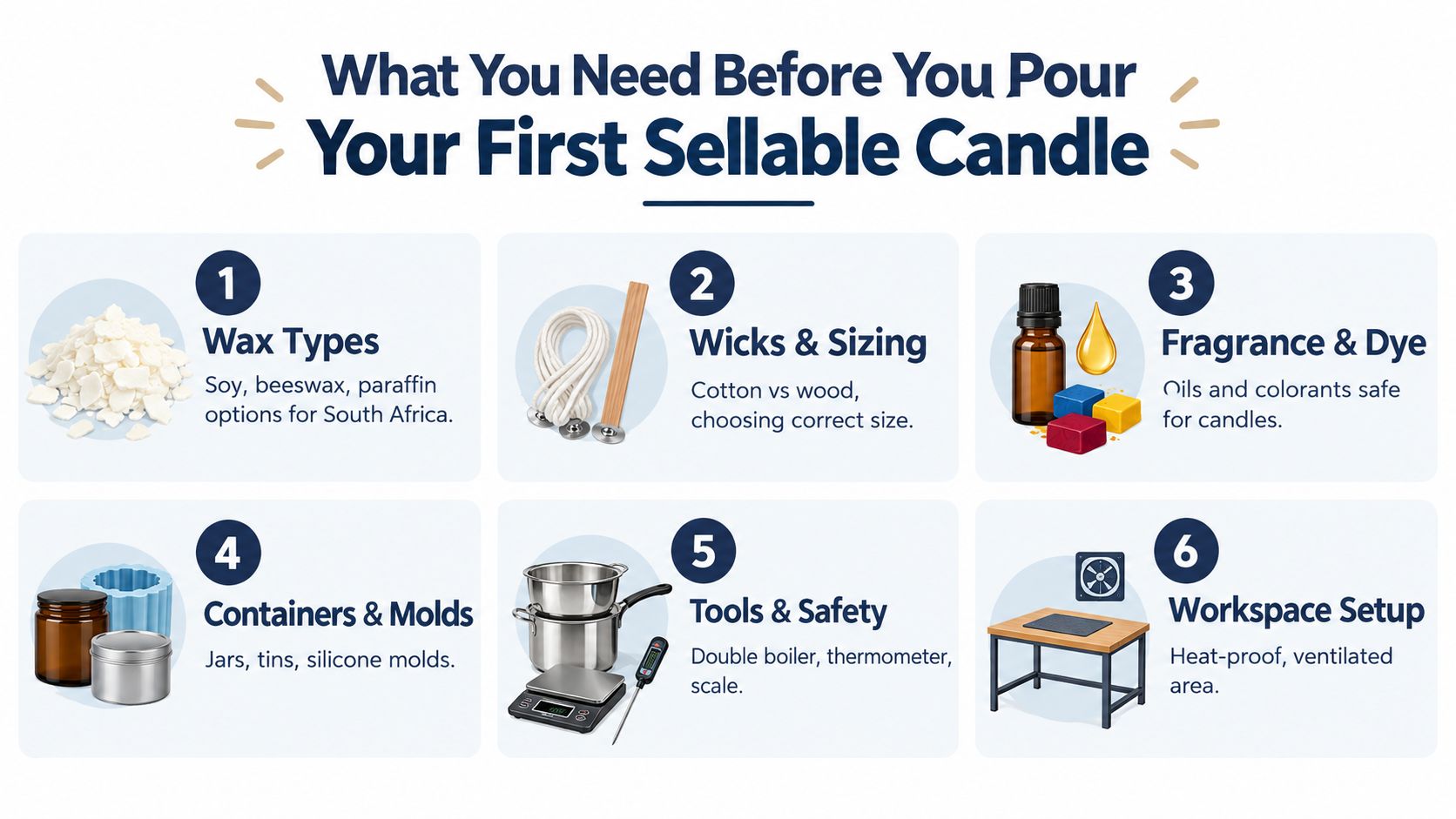
Your starter kit
- Wax: Choose a candle-making wax designed for your product type. Container soy wax behaves differently from wax intended for moulds.
- Wicks: Keep cotton and wood wicks as separate experiments. Wick size depends on the container diameter, wax and fragrance, so don't assume a supplier's general chart is a final answer.
- Fragrance oil: Use oils intended for candle use. Ask suppliers for usage guidance and safety documentation, rather than adding perfume or household fragrance at random.
- Colourant: Candle dyes are safer for formulation than ordinary food colouring, which can separate or behave unpredictably in wax.
- Container: Begin with heat-suitable jars or tins that have a stable base. Avoid repurposing glass unless you're certain it can handle candle heat.
- Equipment: You'll need a double boiler or suitable wax melter, thermometer, digital scale, pouring jug, wick stickers, wick centring tools and heat-resistant gloves.
Set up on a heat-proof, uncluttered surface with ventilation. Keep children, pets, loose clothing and flammable materials away from the melting area. A kitchen scale that measures small changes is more useful than guessing with spoons, because consistent weight helps you reproduce a batch.
Keep a batch record
Write down the wax type, wax weight, fragrance weight, colour, wick model, container and pouring conditions. Give every test combination a simple code. If a candle burns badly, you'll know what to change. If it performs well, you'll know what to repeat.
Buy from established South African candle suppliers where possible, and check that the seller provides clear product descriptions and handling information. A cheap fragrance that forces you to remake a whole batch isn't cheap. Your workspace should save time, not create mystery.
How to Make Candles to Sell With a Repeatable Method
The most useful beginner formula is the one you can record and repeat. Weigh materials instead of relying on volume, keep the same jar and wick during a test, and change one variable at a time. If you change the wax, fragrance and wick together, you won't know which change caused the result.
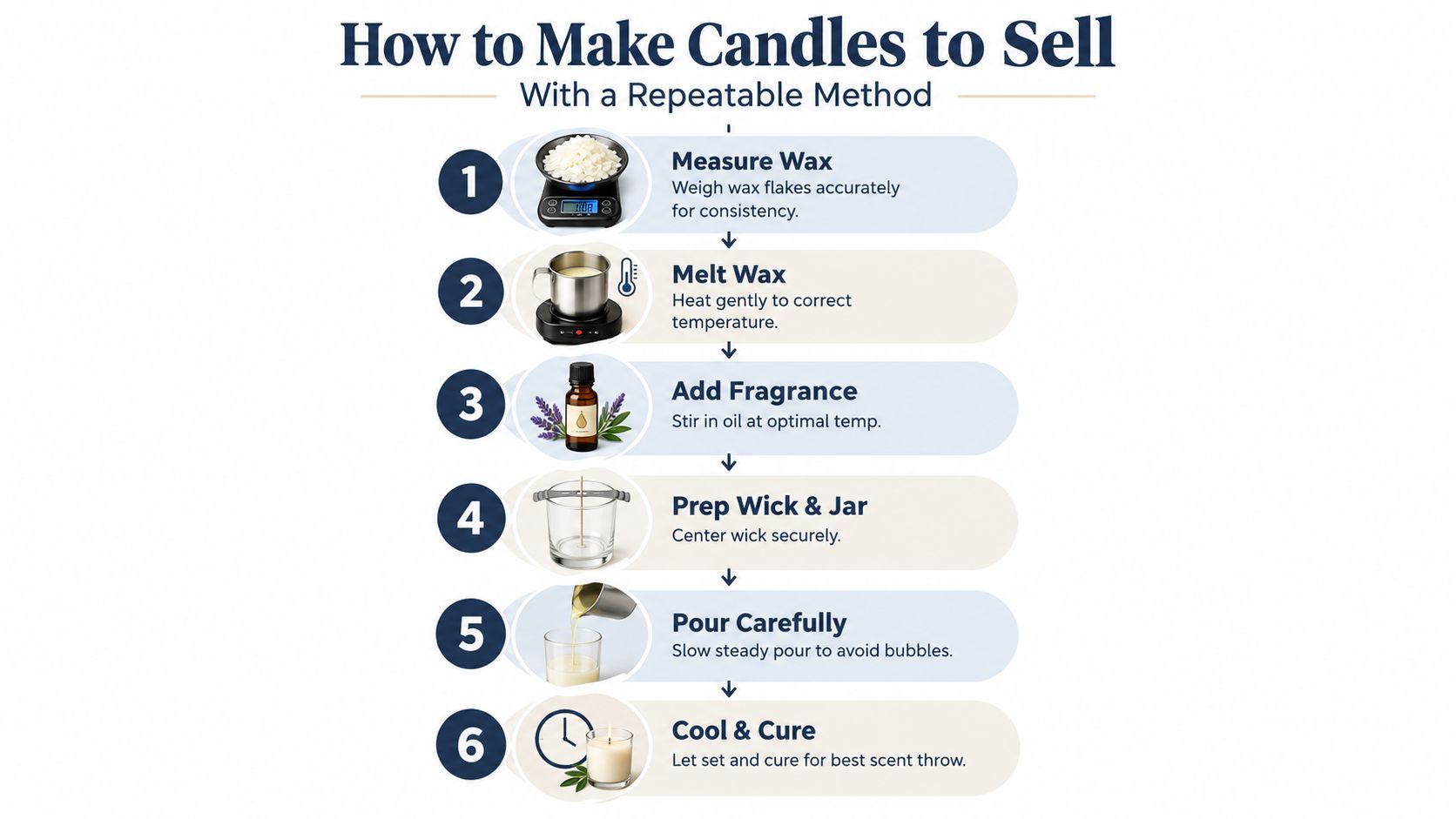
A controlled pour
- Measure the wax. Weigh enough wax for the planned containers and record the amount. Use the same container fill level for each test.
- Melt gently. Heat the wax using a double boiler or suitable melter. Follow the wax supplier's temperature guidance and avoid leaving the pot unattended.
- Add fragrance and colour. Add only candle-safe fragrance and dye. Stir slowly and thoroughly at the supplier's recommended temperature so the fragrance disperses instead of sitting in pockets.
- Prepare the jar and wick. Fix the wick firmly to the centre and hold it upright while the wax cools. A crooked wick can create an uneven melt pool and a hot side of the jar.
- Pour steadily. Pour at the recommended temperature, slowly enough to limit bubbles and splashes. Leave the jars undisturbed while they set.
- Cool and cure. Let the candles harden fully before judging the surface or scent. Cure them according to your wax and fragrance supplier's guidance, then trim the wick to approximately 5 to 6 mm, a length also recommended in South African retail guidance cited by the NWU research.
A candle can look perfect and still fail during burning. Test the exact combination you plan to sell, including the jar, wax blend, wick, fragrance and dye. South African compliance-focused guidance refers to SANS 1896, including expectations that the candle shouldn't smoke or drip under test conditions. The same research notes a domestic candle burn-time target of 9.5 hours.
Use the following video as a visual introduction to the general making process, but treat supplier instructions and your own burn tests as the final authority:
Test several candles from the same batch rather than relying on one lucky result. Watch flame height, soot, container heat, melt-pool progress, scent strength and the condition of the wick. Don't launch a new scent because it smells lovely cold. It must work when lit.
Burn-test standard: The product you list online is the product you test. A formula that works in one jar may fail in another.
Pricing Safety and Legal Must Knows for South Africa
Underpricing is one of the quickest ways to turn a busy candle hobby into an exhausting loss. Add every cost before choosing a retail price. That includes wax, wick, fragrance, dye, jar, lid, label, protective packaging, labour, payment costs, damaged stock and the portion of shipping or delivery administration you absorb.
A simple calculation can look like this:
| Cost Element | What to Include | Example Calculation |
|---|---|---|
| Wax | Actual wax used in the finished candle | Weight used multiplied by supplier cost per weight unit |
| Fragrance | Fragrance used in the tested formula | Weight used multiplied by fragrance cost per weight unit |
| Wick and components | Wick, sticker and centring support | Unit cost for each component |
| Jar and lid | The exact container sold to customers | Supplier price per complete container |
| Label and packaging | Label, box, padding, seal and care card | Total packaging cost per order |
| Labour | Pouring, cleaning, testing, labelling and packing | Your chosen hourly value divided across finished candles |
| Selling overhead | Store, payment, marketing and damaged stock allowance | A reasonable allocation per product |
| Retail price | Full cost plus your profit | Total cost plus the profit you need to keep trading |
You can use this handmade product pricing guide to think through the difference between material cost and a sustainable retail price. Don't copy another seller's price without comparing container quality, scent concentration, packaging, labour and delivery terms.
South African compliance decisions
SANS 1896 testing is a product-quality matter, but legal claims and selling channels require separate attention. If you describe a candle as suitable for skin contact, cosmetic use or a product connected to body care, the Foodstuffs, Cosmetics and Disinfectants Act becomes relevant. Keep claims narrow and factual. “Lavender-scented candle” is clearer than promising medical or therapeutic results you can't substantiate.
VAT planning also matters as sales grow. From 1 April 2026, the compulsory VAT registration threshold increased from R1 million to R2.3 million, and SARS says a small business must register once annual turnover exceeds R2.3 million, as explained in SARS's 2026 budget frequently asked questions. Xero's South Africa VAT guide explains that taxable turnover includes the total value of taxable supplies over a 12-month period, including turnover expected to exceed the threshold in the next 12 months.
Check each marketplace's rules before listing. Import-control developments involving South Africa and China show that candles can fall into higher-risk consumer-goods conformity checks, while adjacent products such as consumer fireworks can require licensing under draft explosives regulations. Don't assume that advice for a candle automatically applies to firelighters, fireworks or other fire-related products.
Branding Packaging and Launching Your Candle Store on Shopstar
A candle buyer sees the label and photograph before they experience the scent. Your brand should make the choice easy. Pick a name that suits the mood you want to create, then use the same colour palette, type style and tone across the jar, website and social posts.
A basic label needs the product name, scent description, net contents where applicable, maker or business details, safety directions and any required product information. Avoid clutter. Customers want to know what it smells like, how to use it safely and what will arrive at their door.
If you're unsure how to turn a personal idea into a coherent visual system, study a strategic brand identity process before ordering a large print run. You don't need an expensive identity package at the start, but you do need decisions you can apply consistently.
Make the product easy to trust online
Photograph the jar near a window in natural light. Use a plain background for the main listing image, then add a close-up of the label, a size reference and a photograph showing the candle in a home setting. Describe scent notes in ordinary language. “Fresh citrus with a soft herbal finish” helps more than a vague phrase such as “a beautiful luxury fragrance”.
Package for movement, not just display. A loose lid, rattling jar or thin box can turn a good product into a refund. Test your packing method by handling it roughly before you begin taking orders, and keep the safety card visible inside the parcel.
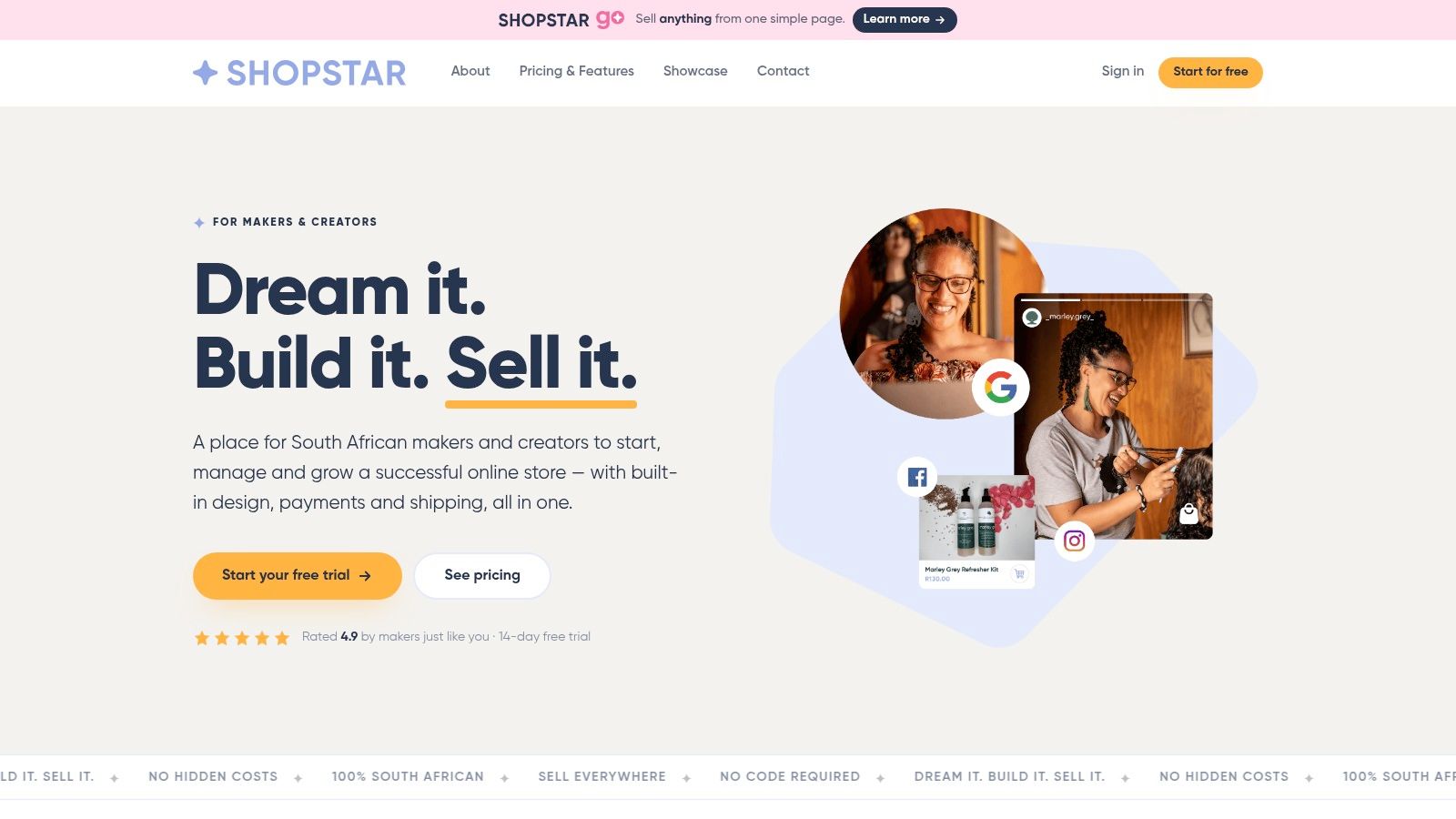
Build the shop around buying decisions
A no-code store builder such as Shopstar lets a maker create product pages, manage stock, accept local payments, arrange shipping and review store activity from one dashboard. Add each scent as a clear product listing rather than hiding several unrelated fragrances under one confusing title. Include the jar size, scent profile, care instructions, dispatch information and whether the item is made to order.
Set up your store before announcing it. Check the mobile view, place a test order, confirm payment notifications, review delivery charges and make sure sold-out items don't remain available. Then connect the store to the places where South African customers already find you, such as Instagram, Facebook, WhatsApp and Google.
Use a short launch checklist:
- Product pages: Add clear photographs, scent notes, care instructions and stock levels.
- Payments: Confirm that local payment options work from a customer's device.
- Delivery: State where you deliver, what customers pay and when orders leave you.
- Promotion: Prepare launch posts, behind-the-scenes content and a direct store link.
- Customer support: Decide how quickly you'll answer scent, delivery and burning questions.
For a more candle-specific setup, follow Shopstar's guide to starting an online candle store in South Africa. Keep your first launch small enough to fulfil. A polished store with a focused range is easier to manage than a large catalogue you can't restock consistently.
Practical Tips to Sell More and Keep Customers Coming Back
The makers who last usually stop treating every new scent as progress. A new product only helps when you can make it safely, describe it accurately, photograph it well and keep it available. A focused range gives you more time to improve the listing, collect feedback and create useful content.
Test in small batches and keep your records. If customers love a particular scent, protect its consistency by ordering the same materials where possible and checking each new supply batch. Different jars can change the heat behaviour, and a different wick can alter the burn even when the wax appears identical.
Fix the mistakes that cost beginners money
Too much fragrance can create sweating, poor adhesion or an unstable burn. More scent isn't automatically better. Follow the wax and fragrance supplier's guidance, then test the finished candle.
The wrong wick can cause tunnelling, smoking, a weak flame or excessive heat. Test alternatives in the same container and change only one factor at a time.
Too many containers make stock and packaging harder to control. Choose a dependable jar or tin and build recognition around it before adding unusual shapes.
Weak product descriptions leave online shoppers guessing. Explain the scent, size, intended mood, care instructions and delivery expectations in plain language.
Making instead of marketing is another common trap. Once you have tested stock, spend time showing the process, answering questions, asking buyers for reviews and reminding interested people where to order. Reviews should describe genuine customer experiences, not claims you've written for them.
Use your store's order and product data to notice patterns. If one scent sells repeatedly while another sits untouched, adjust the range rather than continuing to pour both equally. Prepare gift bundles for seasonal demand, but don't create more combinations than you can label and pack accurately.
Customer retention doesn't require a complicated scheme. A thank-you message, careful packaging, useful burn guidance and a straightforward reorder path can do a great deal. When you're ready to formalise repeat buying, review customer loyalty programme ideas for online stores and choose an approach that still leaves room for profit.
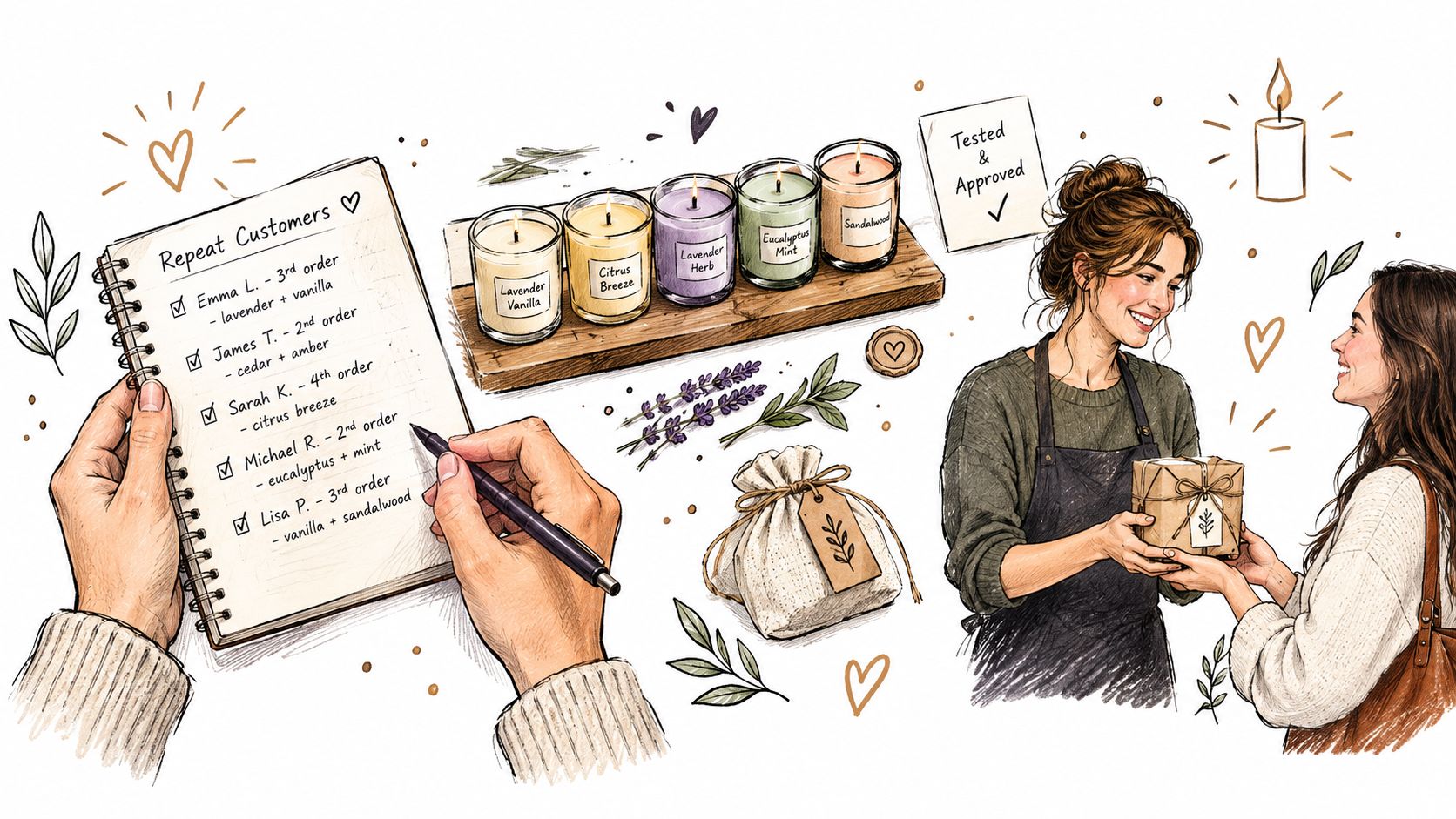
Start with one tested candle, one dependable container and a small online range. Improve the product from real burn results and customer questions, then add stock only when your process can handle it. That steady approach gives your candle business a much stronger base than rushing into a large catalogue.
Shopstar gives South African makers the tools to create an online store, manage products and inventory, accept local payments, organise shipping and promote products through channels such as Instagram, Facebook, WhatsApp and Google. Visit Shopstar, set up your candle store and use the trial period to test your product pages and checkout before inviting customers to buy.