Social Selling Strategy for South African Makers That Sells
September 22, 2026 · 15 min read · Bronwyn Furno
You've posted your handmade earrings on Instagram, shared them to Facebook, and checked TikTok comments between orders. Someone asks, “How much?” You reply later. By then, they've moved on, and you're left wondering why attention isn't becoming sales.
That's the gap a practical social selling strategy should close. Social selling isn't about posting constantly or sending awkward messages to strangers. It's about helping people discover your products, answering their concerns, showing that you're trustworthy, and giving them a simple way to pay. For a South African maker, that usually means discovery on Instagram, Facebook, or TikTok, followed by a helpful WhatsApp conversation and a clear online checkout.
Table of Contents
- What Social Selling Really Means for South African Makers
- Know Your Buyer and Pick the Right Channels
- Content and Messages That Build Trust Before You Sell
- Turn Chats Into Checkouts With Your Shopstar Store
- Track What Matters and Fix What Is Not Working
- Quick Wins and Next Moves to Keep Momentum
What Social Selling Really Means for South African Makers
A small jewellery brand in Cape Town might begin with a Reel showing how a pair of polymer clay earrings is made. Someone shares it with a friend. The friend visits the profile, checks the comments, and sends a WhatsApp message asking whether the earrings are lightweight and whether delivery is available to Gauteng.
That conversation is social selling. The maker isn't forcing a pitch. They're answering a real question, sharing a product link, explaining delivery, and helping the buyer feel comfortable enough to order.
South Africa has a large audience for this kind of journey. The country had 35.15 million social media users in 2023, alongside 43.5 million internet users overall. Facebook usage among respondents rose from 56.7% in 2022 to 59.6% in 2023, while TikTok grew from 30.6% to 34.0% over the same period, according to South African digital marketing statistics. These figures point to a simple change in shopping behaviour. People often discover products inside social apps before they visit a traditional online store.

The three moments that matter
Your customer normally moves through three moments:
- Discovery: They see your necklace, woven basket, skin-care product, or clothing item in a post, video, search result, or recommendation.
- Trust: They look for signs that you're genuine. They may read reviews, inspect your profile, ask questions, or check whether your payment process feels secure.
- Purchase: They click a product link or move into a chat that ends with a straightforward checkout.
South African consumer behaviour supports this order. 83% of surveyed consumers use social media to discover new brands, 82% seek reviews before buying, and 41% buy directly through social media, as reported by ITWeb's coverage of social commerce in South Africa. That means a “Buy now” message may arrive too early if your page hasn't answered the buyer's doubts.
Your store is the home base
Instagram, Facebook, TikTok, WhatsApp, and Google each play a different role. Social platforms help people find you and start conversations. Google can help someone who already knows what they want. Your Shopstar store gives those interested shoppers one place to view products, understand delivery, choose payment, and complete an order.
Think of it this way. Social media starts the conversation. WhatsApp helps you close the conversation. Your online store handles the transaction. Once you see the system this way, you won't need to chase every new trend. You'll build a repeatable path from attention to payment.
Know Your Buyer and Pick the Right Channels
Before choosing platforms, describe one real customer. Don't write “women aged 18 to 50 who like fashion”. That description is too broad to guide your content.
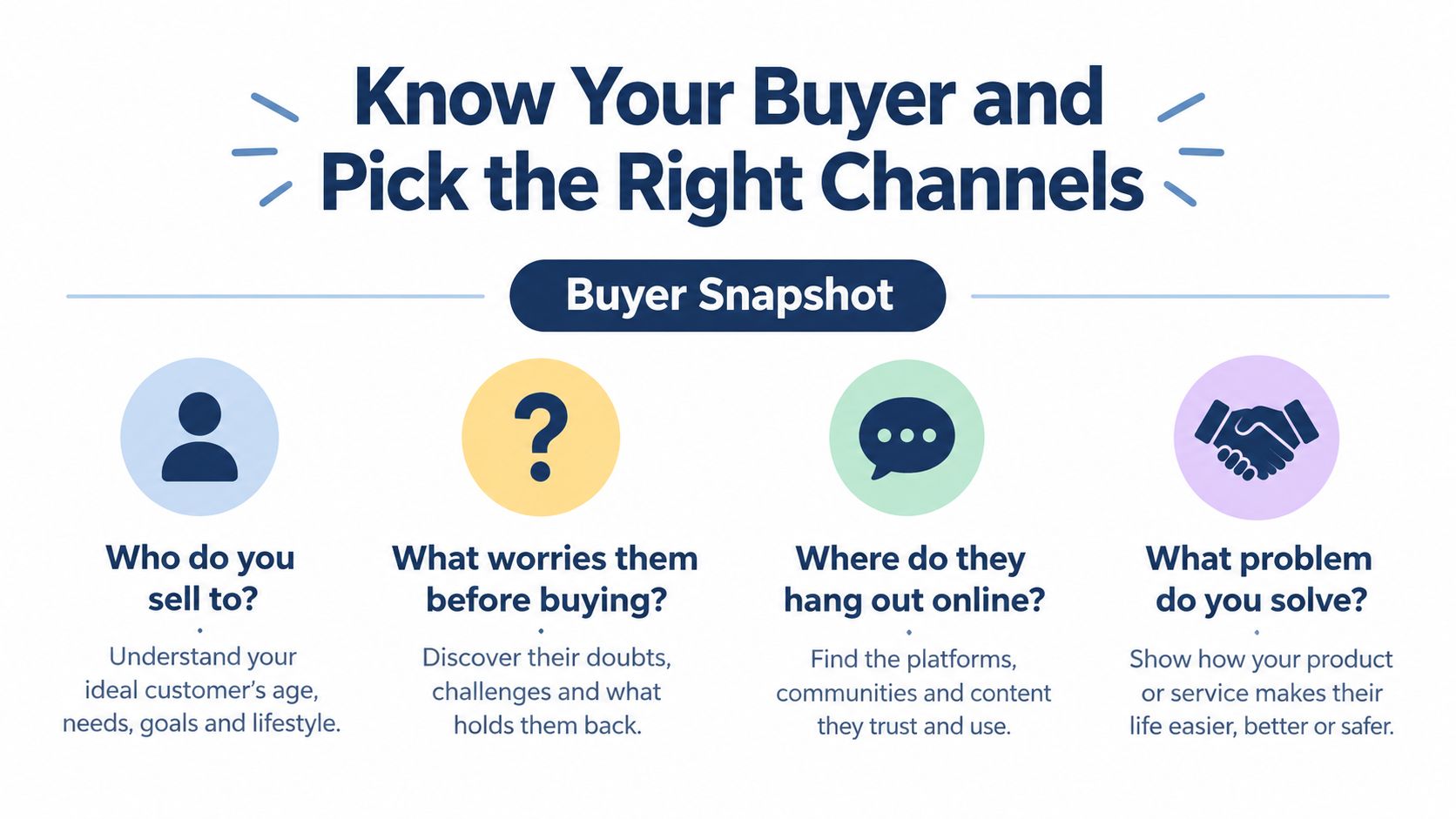
Use a plain-language buyer snapshot instead:
- Who do you sell to? For example, a young professional buying bold earrings for work and weekends.
- What worries them before buying? They may wonder whether the earrings are comfortable, whether the colours match the photographs, or whether delivery will be reliable.
- Where do they spend time online? They may browse Instagram for style ideas, use WhatsApp to ask questions, and check Facebook recommendations from local groups.
- What problem do you solve? You offer distinctive accessories that make an outfit feel finished without visiting a shopping centre.
Start with local attention
Early-2025 data recorded 26.7 million active social media users in South Africa, with internet users spending 3 hours 36 minutes per day on social media. The same source found that 63% of users actively seek brand content. Platform adoption included WhatsApp at 93.8%, Facebook at 88.6%, Instagram at 71.4%, and TikTok at 76.9%, according to Meltwater's South African social media statistics.
These numbers don't mean you must publish everywhere. They show why a WhatsApp-first, Meta-heavy workflow makes sense for many local makers. Use Facebook and Instagram for visibility and proof. Use WhatsApp for personal questions and purchase support. Add TikTok when short videos suit your product and you can maintain them without neglecting customer service.
Use a simple channel test
Ask these questions before opening another account:
- Can I create useful content for this platform?
- Does my buyer already use it?
- Can I answer messages within a reasonable time?
- Can I send interested people to one clear product page?
- Will this channel help me learn something about customer demand?
If the answer is no to most of these, leave the channel for later. A quiet, neglected profile can make a business look inactive.
For a deeper explanation of how social platforms can support an online store, read Shopstar's guide to social e-commerce. The important principle is focus. Start with one discovery platform, one trust-building platform, and WhatsApp for high-intent conversations. You can expand after the first system feels manageable.
Content and Messages That Build Trust Before You Sell
Your content needs a job. A post can help a new person find you, reassure an uncertain buyer, or invite someone who's ready to shop. If every post asks for an order, followers may stop paying attention.
Use three content types in a simple rhythm.
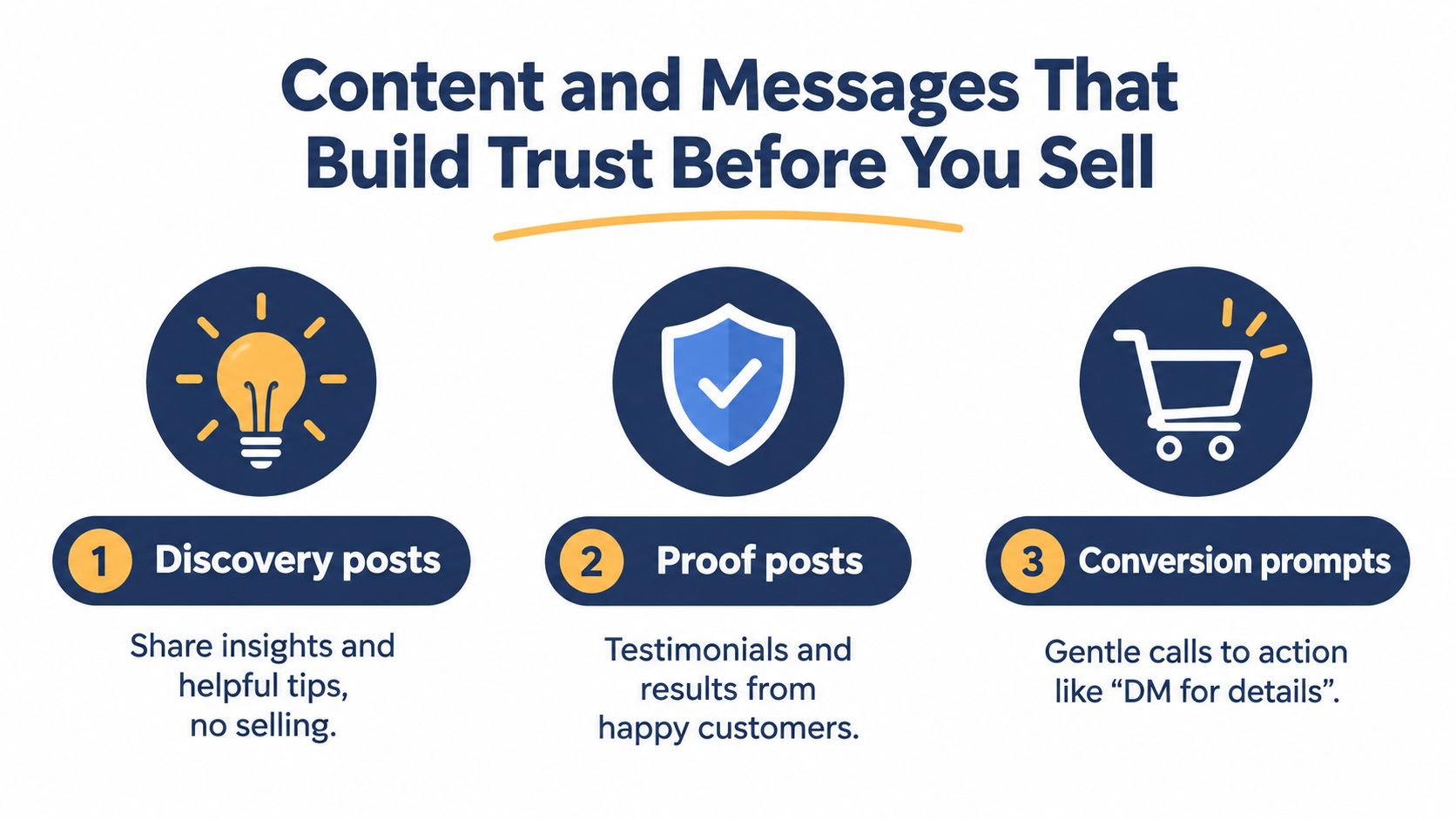
Discovery posts
Discovery content helps people understand your niche. A handmade decor seller could show how to style a small shelf in a rental flat. A jewellery maker could explain how to store brass pieces. A boutique fashion brand could demonstrate three ways to wear one linen shirt.
Try captions like:
Helpful caption: “If your earrings feel heavy after a few hours, look for a lightweight base and a comfortable hook. These pairs are made for long days, from morning meetings to dinner.”
The post doesn't need a hard sell. It should give the reader a reason to remember you.
Proof posts
Proof answers the quiet question, “Can I trust this seller?” Share clear customer reviews with permission. Show the actual product in natural light. Photograph packaging, your workspace, sizing, finishes, and care instructions. Explain what happens after payment.
A proof caption might read:
“Thandi chose the sand-coloured basket for her entryway. She wanted something neat for blankets but still handmade. Here's how it looks in her home, shared with permission.”
Avoid claims you can't support. A real review, a visible store profile, and a secure payment explanation are more useful than exaggerated promises. South African retail research identifies security and verification as important trust levers, including verified merchants, secure gateways, fraud alerts, and biometric authentication, as discussed in Mastercard's South African online retail report.
Conversion prompts
Once people have seen useful information and proof, invite action gently:
- “View the available colours through the product link in our bio.”
- “DM us if you'd like help choosing a size.”
- “Send us a WhatsApp message for delivery details.”
- “The full product description and checkout are available through this link.”
Keep a few natural replies ready. A saved Instagram response could say, “Thanks for asking. This design is lightweight and available in the colours shown in the product page. You can view the details and checkout here: [product link].”
For WhatsApp, write like a person, not a robot: “Hi, thanks for your message. I can help you choose between the small and medium basket. The small works well for shelves, while the medium gives you more storage. Would you like the product links?”
You can also learn how to turn one useful idea into several formats with this guide to repurposing transfer content. A short tutorial can become a Reel, a carousel, a Story, and a WhatsApp status without starting from scratch each time.
Turn Chats Into Checkouts With Your Shopstar Store
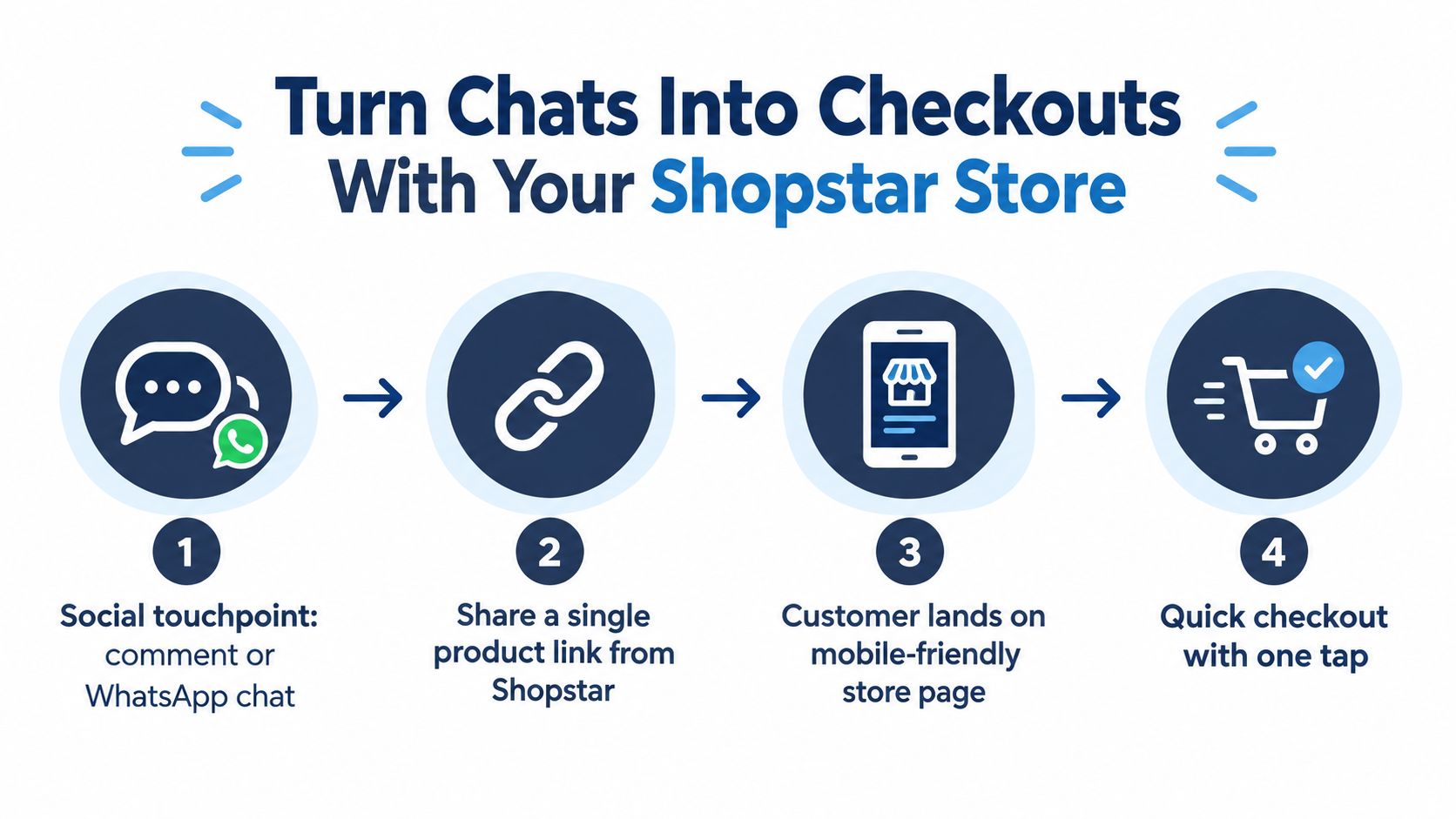
A social selling strategy becomes much easier when every conversation has a clear next step. The next step shouldn't be “Please send your details and I'll calculate everything later” unless your product requires a custom quote. For standard products, send one product link that contains the information the buyer needs.
Build one clean path
Set up your catalogue so each product page answers common questions:
- What is the product?
- What are its dimensions or size options?
- Which materials or colours are available?
- What does the customer receive?
- What are the delivery details?
- Which payment methods are available?
- How can the buyer contact you if something goes wrong?
For a jewellery brand, a product page might include a close-up image, a photograph showing scale, the earring measurements, the materials, care advice, and the delivery information. Then your DM can stay short: “Here's the link to the terracotta hoops. You'll find the size, materials, delivery details, and checkout on the page.”
South African buyers are already using mobile and social channels heavily. One source reports WhatsApp usage among 78% of South Africans, Facebook usage among 72%, and Instagram usage among 65%, as recorded in South African social media community data. Your product page must therefore work comfortably on a phone, with readable text, clear images, and a checkout that doesn't create unnecessary effort.
Move high-intent chats to WhatsApp
Instagram and TikTok are useful for discovery, but a buyer with detailed questions may be easier to help on WhatsApp. Move the conversation when the person asks about stock, delivery, customisation, payment, or combining products.
Don't move everyone automatically. A public comment can receive a public answer first, especially when the answer may help other shoppers. Use WhatsApp when the conversation needs personal attention or when the buyer is ready for a direct product link.
Keep one-to-one chats for specific buying help. Use broadcast lists for useful updates such as new stock, seasonal collections, or delivery cut-offs. Don't send every post to every contact. People should understand why they're receiving the message and how to stop future updates.
This guide to selling on WhatsApp can help you think through catalogue links, replies, and customer conversations. The principle is simple: WhatsApp is the conversion engine, not the entire marketing machine.
A short video can also help you connect the pieces:
Make payment and delivery feel safe
Tell customers exactly what happens after checkout. Confirm that they'll receive an order acknowledgement, explain your delivery process, and show the name of your business consistently across your profile, product page, payment records, and messages.
If someone asks whether your store is legitimate, don't become defensive. Share your business details, reviews, product photographs, secure payment information, and store link. A buyer doesn't need pressure. They need enough clear evidence to make a comfortable decision.
Track What Matters and Fix What Is Not Working
You don't need a complicated spreadsheet to improve your social selling strategy. Check a small set of numbers once a week and connect each one to a part of the customer journey.
Start with five useful signals
Profile visits show whether your posts are making people curious enough to learn more. If profile visits are low, improve your opening image, first sentence, product explanation, or discovery topics.
DM response time shows how quickly you help interested people. A good process means checking messages regularly, using saved replies for common questions, and adding a personal sentence instead of sending a cold template.
Shopstar link clicks show whether your content and conversations are creating buying interest. If people view your profile but don't click, your bio or call to action may be unclear. If they ask questions but don't receive a link, your manual process may be slowing the sale.
Add-to-carts show that the product page has created stronger interest. If clicks are healthy but add-to-carts are weak, inspect photographs, pricing information, sizing, delivery wording, and product descriptions.
Completed orders are the clearest outcome. Compare them with the posts, conversations, and product links that preceded them. You're looking for patterns, not perfect attribution.
Practical rule: Fix the earliest weak step first. More posts won't solve a product page that leaves buyers confused about delivery.
Shopstar analytics can sit alongside Instagram Insights and WhatsApp Business information. You don't need to track every like. A post with fewer reactions may still matter if it sends the right people to a product page or starts useful buying conversations.
For a clearer setup, use Shopstar's ecommerce tracking tools guide. Keep weekly notes in plain language: “The care tutorial brought questions about brass jewellery,” or “The customer photo led to product clicks.” Those observations can shape your next content choices.
If sales are quiet, check the path in order. Are the right people discovering you? Do they see proof? Are you replying clearly? Does the link open the correct product? Can a customer understand payment and delivery without asking several more questions?
Quick Wins and Next Moves to Keep Momentum
You don't need to rebuild your entire business this week. Choose one product, one buyer, and one clear path from social discovery to WhatsApp to checkout.
For a jewellery brand, film a short styling video, add a customer review to your profile, and prepare a WhatsApp reply covering size, materials, care, and delivery. For a handmade decor shop, photograph one product in a real room, explain its dimensions, and send interested shoppers directly to its product page. For a boutique fashion label, show the fit from more than one angle, answer common sizing questions, and use WhatsApp for personal recommendations.
Your next 30 days
- Choose one hero product: Make one item easy to understand and easy to buy.
- Write your buyer snapshot: Record who wants it, what worries them, and where they spend time online.
- Create the three content types: Publish discovery, proof, and conversion content.
- Prepare your replies: Save answers for price, stock, delivery, payment, sizing, and returns.
- Connect every channel: Check that Instagram, Facebook, TikTok, WhatsApp, and Google lead to the right store or product link.
- Review weekly signals: Look at profile visits, replies, clicks, add-to-carts, and completed orders.
- Improve one weak point: Change one photograph, answer, product detail, or call to action before adding more work.
South Africa's online retail market is projected to reach R159-billion in 2026, with annual growth of 22.5%, and is expected to represent about 10% of total retail turnover for that first full calendar year, according to The Media Online's reporting. That makes a focused online store a sensible path for a maker who wants to test demand without opening a physical shop.
Shopstar offers a no-code store builder with ready-made themes, local payments, shipping, orders, inventory, analytics, and connections for selling through Google, Instagram, Facebook, and WhatsApp. Its Cape Town Customer Success team supports local entrepreneurs, and the platform includes a 14-day free trial with no credit card required.
Start with one product and build the path today, discovery on Instagram, Facebook, or TikTok, helpful answers on WhatsApp, and a clear mobile checkout. Visit Shopstar to create your South African online store and test your social selling strategy with the tools in one place.